A Series of Small Miracles
Three claims from one interview, and the documents that answer them.
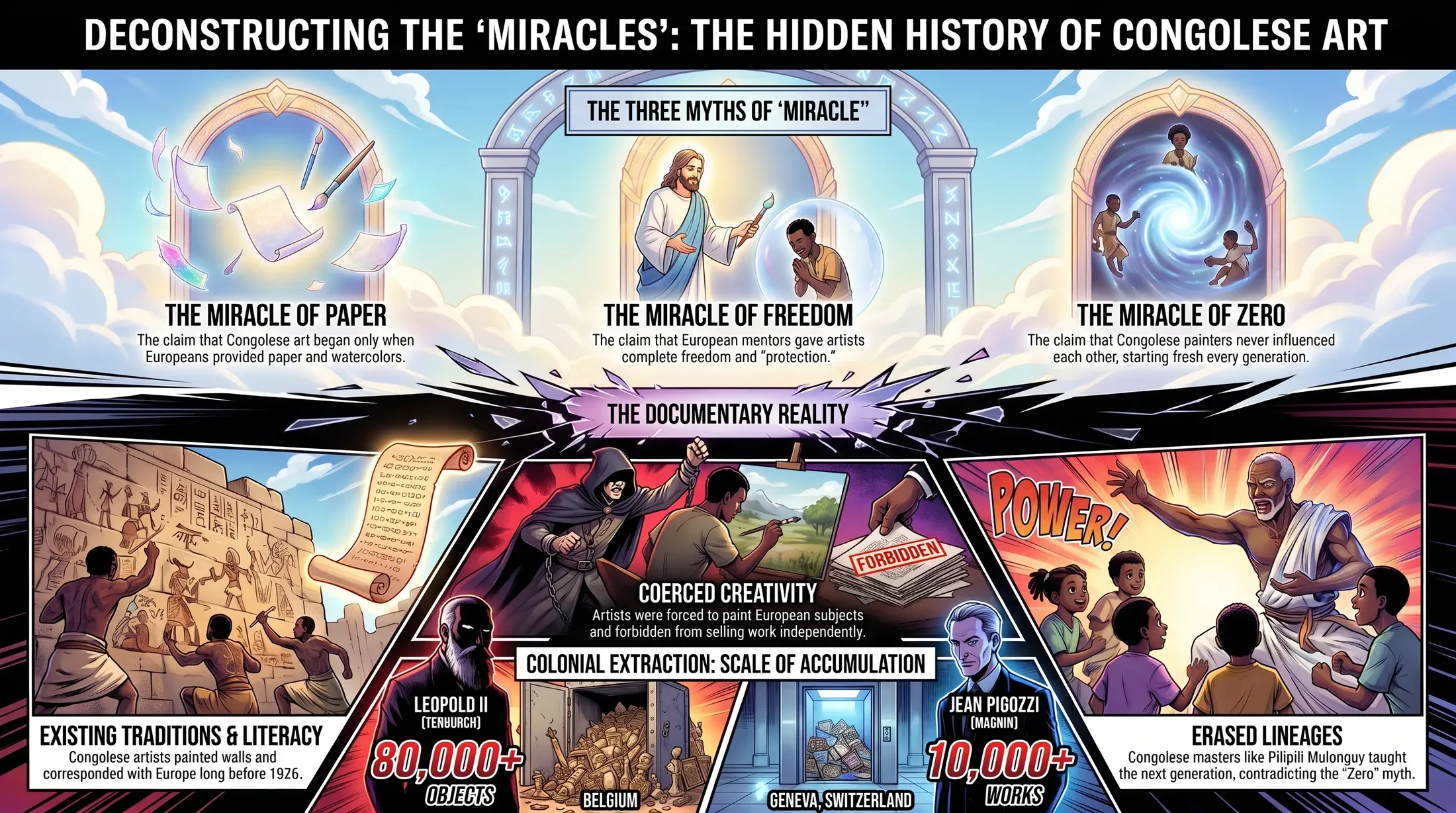
The watercolours that open the canon in 1926 came from the office of a Belgian clerk who also took in the head tax. On the painters’ own tapes, the freedom of the Élisabethville studio meant painting what its French director painted and selling to nobody. The curator who calls all of this a miracle bought close to ten thousand of the results.
In November 2015 André Magnin, curator of Beauté Congo 1926–2015, the largest exhibition of Congolese art ever mounted, told a Paris magazine how the art had come to exist. Since 1926, he said, Congo had benefited from a series of small “miracles.” The printed text puts the word in quotation marks every time. Whoever added them knew what it was carrying.1
The miracles come in three claims. Paper: the painters became precursors because they were the first Congolese with access to paper and watercolors, where the painters of house walls had only earth and charcoal. Freedom: passionate individuals gave them materials, guaranteed complete freedom, and protected them from an education that would have spoiled them. Lineage: no group of Congolese painters influenced the next; each started from zero. The exhibition’s first date is the year a Belgian clerk in Katanga started handing out watercolors. That is where the canon begins. The record begins elsewhere.
The first miracle: paper
Albert Lubaki was Bakongo. His people had been writing to Lisbon since the 1510s, and had been Catholic for longer; a church with catechisms, chapels, and a clergy of its own is a church with images, on walls and on paper.2 That none of them survives in a European collection says what Europe was collecting in the Congo before 1926, and it was not paintings. The inference is plain: the record is empty because nobody bought it, not because nobody made it. Nor was painting on walls a rumor: Thiry found Lubaki’s work on house walls before he handed anyone a sheet.3 What Thiry brought was a buyer, a wage, a quota, and a route to Brussels, from the office that also collected the head tax and issued the pass without which a Congolese man could not leave his district.4
As for earth and charcoal: painters in Kinshasa today stretch rice bags and printed wax and grind pigment from earth and fruit, in a city where acrylic is sold on every avenue.5 The materials were never the miracle.
The second miracle: freedom
After the war a retired French naval officer, Pierre Romain-Desfossés, ran a studio in Élisabethville registered as the Académie d’art populaire indigène. The exhibition catalogue of 2021, from Hong Kong University Press, records his method: he encouraged his students to “sit under a tree” to find their original “black soul,” and described Mwenze Kibwanga’s painting as revealing “a more complex being than the average native.” The catalogue notes that this language “now resonates as offensive” and, in the same sentence, that his pedagogy was “sympathetic.”6 Now. It resonated at the time, to the men under the tree.
The painters described the freedom from inside, on Johannes Fabian’s tapes of 1974 and 1979, twenty years after the studio closed and the only time anyone asked them.7 Bela, who painted with his fingers, was Desfossés’s orderly, brought from Chad and handed a brush. Mwenze arrived with a style of his own, the catalogue says, “which he would quickly abandon”; asked whether Desfossés pushed them to paint simply and authentically, like Africans, he said yes. They were not allowed to sell their own work; a sale to a friend was done, in Mwenze’s word, secretly, and the buyers were Belgians. When Desfossés applied to open an art school, the Belgian authorities refused to have one open to Africans. Desfossés painted marine life; Bela’s fish, the catalogue says, were a subject “he shared with Romain-Desfossés.” Given complete freedom, a studio of Congolese men from three countries painted, for eight years, animals and plants.
That is the complete freedom: paint what the Frenchman paints, sell to no one, speak to no one, and found no school while he lived.
The third miracle: zero
When Desfossés died in 1954, Pilipili Mulongoy, Mwenze, Kaballa, and Bela taught the next generation at the Élisabethville academy, in a section of their own; Mwenze stayed until 1984. Pilipili on tape: “I started the Academy.” Magnin knows this. In the same interview, in the paragraph that announces the second miracle, he names the four as the painters who taught at the school Laurent Moonens had just opened. He mentions the teachers and starts the clock at the Frenchman. Zero is the older verdict: too primitive to inherit, so that every generation begins from nothing and the next good thing can arrive from outside and be called a miracle too. Moonens, for his part, taught his European students to draw and his Congolese students nothing of the kind, because, in his words, “the native is a born artist.”8
A lineage of Congolese teachers leaves no room for miracle workers, and no room for the miracle he does not count, which is his own. His catalogue essay opens by calling the show the fruit of chance and necessity, and the chance was him. Between 1989 and 2009 Magnin bought nearly ten thousand works for the collector Jean Pigozzi, and they are in Geneva. The last time Congolese art left the country in those quantities, the man moving it was Leopold II, and it went to Tervuren.9 A man who has been the primary gatekeeper for a country’s art, describing that art as miracles performed by men like him, has described himself with some precision. The quotation marks were the honest part.
Among the artists in the exhibition there was one woman, Antoinette Lubaki.10 The record holds two sheets in the Royal Library of Belgium on which another painter’s name, Alphonse Kalenga, was painted over to make room for hers and her husband’s; a letter from her husband asking Thiry for money to pay the men who worked with them; twelve sheets sent to Geneva in 1939 under the household name; and not one sentence she said.11 She is in the exhibition. She is not in the history it tells.
The Lubaki and Hangar histories are told at length on kitokongo.art.
Notes
11
-
André Magnin, interview by Armelle Leturcq, Paris, November 2015, Crash (online 2 May 2017). The four teachers appear there as Bela, Kalela, Pilipili, and Mwenze; the figure of nearly 10,000 works bought for Pigozzi between 1989 and 2009 is his own, in the same interview. ↩
-
Afonso I’s letters, 1509–1541: Brásio, Monumenta Missionaria Africana, vol. 1. Cardoso, Doutrina Christã, Lisbon, 1624. ↩
-
Lubaki Bakongo, and the house walls: Georges Thiry, À la recherche de la peinture nègre, 1982, cited in Thomas Bayet, “Origins of Congolese Painting,” in Colours of Congo: Patterns, Symbols and Narratives in 20th-Century Congolese Paintings, ed. Florian Knothe and Estela Ibáñez-García, Hong Kong University Press / UMAG, 2021, pp. 24–25. ↩
-
Head tax and pass: royal decree of 16 March 1910, registration of adult men by chiefdom, carte d’identité recording tax, inoculation, employment, and changes of residence. Raymond Leslie Buell, The Native Problem in Africa (New York: Macmillan, 1928), vol. 2, pp. 496–520; David Van Reybrouck, Congo: The Epic History of a People (2010; Eng. 2014). ↩
-
Rice bags and printed wax: Skander Kacem, artist interviews with Lianza and others, kitokongo.art. ↩
-
Desfossés: Jenny Leung Yuen Ki, “The Pedagogy of Pierre Romain-Desfossés,” Colours of Congo, pp. 91–93: official name (p. 91); “sit under a tree,” “black soul” (p. 93, citing Njami 2007, p. 234); “his children” (p. 93, citing Mudimbe 2005, p. 159); “resonates as offensive” and “sympathetic” (p. 93); marine life shared with Bela (p. 92). “A more complex being than the average native”: Desfossés quoted in Bayet, catalogue entry Mwenze Kibwanga, p. 139. Mwenze’s mission drawing lessons, portraiture, and abandoned style: p. 139. ↩
-
Johannes Fabian, “Conversations with the painters Mwenze Kibwanga and Pilipili Mulongoy,” Archives of Popular Swahili 13 (2011), Texts Two and Three. ↩
-
D Section, Pilipili assistant to 1959, Mwenze to 1984: Colours of Congo, pp. 119, 139. Moonens, “dreary, soulless paintings,” Moonens Archives, “The Congo years, 1948–1949,” quoted in Bayet, “The Academy of Fine Arts of Elisabethville,” p. 147. “The native is a born artist” and separate methods for European and Congolese students: Fatima Soumahoro, “The Methodology of Moonens and Lods,” p. 163. “Founding myth of a European father figure,” “noble savages”: same page, citing Greani 2012, p. 261. ↩
-
AfricaMuseum, Tervuren, 1897 colonial exposition and the museum it became; “Cultural heritage collections”: ethnographic holdings about 120,000 objects, the great majority from Central Africa and in particular the DRC. BRUZZ, 18 January 2024: 128,000 cultural objects, about 80,000 from Congo. The Brussels Times, 2022: inventory of 85,000 Congolese objects, 1885–1960, handed to the DRC government. CAAC / jean-pigozzi.com: more than 10,000 works, Geneva, no permanent venue. ↩
-
Single female artist and the catalogue’s opening line: African Arts 49:4 (2016). Geneva 1939: Magnin (note 1); MAGNIN-A. ↩
-
Kalenga’s painted-over signature and the shared authorship of the Lubaki sheets: Colours of Congo, pp. 38–39. École d’essais picturaux: letters of 24 April 1931 and 20 February 1932, Dierickx Archives, P. Loos Archives. Kalenga’s concealed signature: two sheets, Cabinet des Estampes, KBR. Letter from Lubaki to Thiry, 10 February 1927, Dierickx Archives, documentation Pierre Loos. ↩
Get new pieces by email
Two to four essays a month. The list is never sold or shared, and you can unsubscribe in one click.
Comments
Comments are read before they appear. Disagreement is welcome; abuse is not.
No comments yet.