

Adwa after the photograph
Italy lost an army. The record lost the winners.
Italy lost an army at Adwa on 1 March 1896. The New York Times found the winners Caucasian by April; Britain, France and Italy divided Ethiopia into spheres of influence by 1906; Italy came back with mustard gas in 1935.
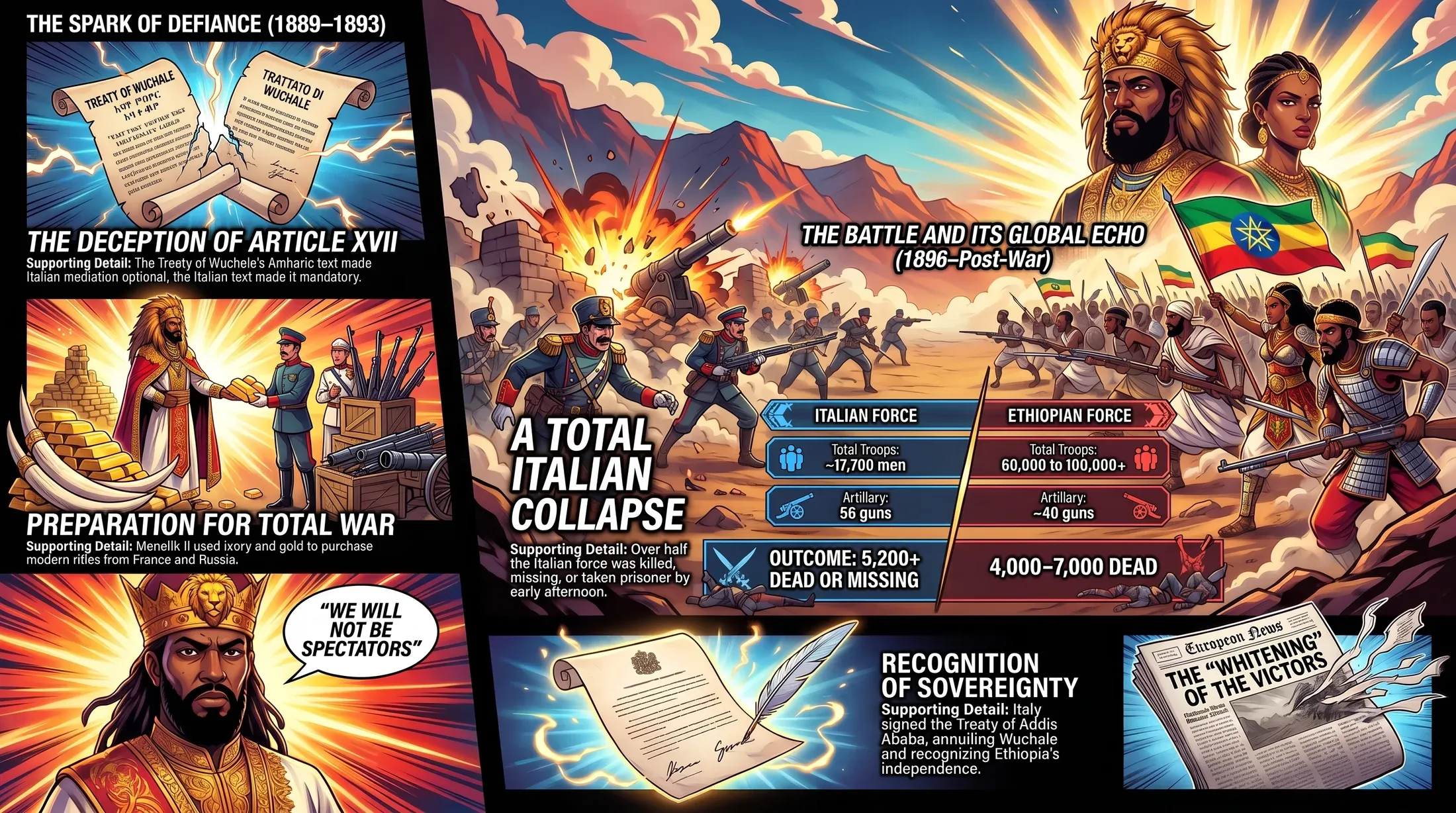
On the morning of 1 March 1896, on the hills around the market town of Adwa in Tigray, the army of Emperor Menelik II destroyed the Italian expeditionary force in Ethiopia. General Oreste Baratieri had marched out the night before with about 17,700 men in four brigades, one of them Eritrean askari (African soldiers under Italian officers), and fifty-six guns. By early afternoon the guns and eleven thousand rifles belonged to Menelik. The Italian returns listed 289 officers, 2,918 Italian soldiers and some 2,000 askari dead, 954 missing, 1,428 wounded, and, on Berkeley’s count, 1,865 Italians and 2,000 askari taken prisoner, among them a brigadier general. More than half the force did not come back.1
Eleven years earlier, at Berlin, the European powers had written the rule of the partition. A claim to African territory stood if the claimant could show effective occupation; no one had to prove the land empty. The powers treated the states already on it, states with treasuries, standing armies and diplomatic relations older than several of the governments dividing them, as incapable of holding title. By 1914 they had put every territory on the continent under a European flag except two: Liberia, settled from 1822 by the American Colonization Society, and Ethiopia. Adwa made Ethiopia the exception, and it broke the premise under the whole partition, that no African state could meet a European army in the field.
Italy had come late to the coast. The Italian state took over the Red Sea anchorage at Assab in 1882, landed at Massawa in 1885 and declared the colony of Eritrea on 1 January 1890. The highland empire behind the coast was the next object. On 2 May 1889 Menelik, king of the central kingdom of Shewa and six months from his coronation as emperor, signed the Treaty of Wuchale with Count Pietro Antonelli. The treaty existed in two languages, and Article XVII did not say the same thing in both. The Amharic text allowed the emperor to use Italy’s government for his dealings with other powers if he chose. The Italian text bound him to it. A ruler who must conduct his foreign relations through another state is, in the vocabulary of the period, a protectorate, and a protectorate is the first legal step to a colony: France had taken Tunisia that way in 1881. In October 1889 Rome notified the other European governments that Ethiopia was now under Italian protection, and every one of them accepted the claim except Russia and the Ottoman Empire.2
By 1890 the court in Addis Ababa knew how Rome read the article. Antonelli came back that year to hold Menelik to it. Empress Taytu Betul, who had named the capital four years earlier and would bring her own regiments to Adwa, refused the article inside the negotiation, and the refusal held. In February 1893 Menelik sent the European governments a circular letter denouncing the treaty. The war that followed was fought over one sentence with two meanings.3
Menelik prepared for it the way a state buys a fleet. Through the 1880s and 1890s his agents bought rifles from France, Russia and Italy itself (Gras, Berdan, Vetterli, Remington) and some forty guns. France and Russia sold because each preferred an independent Ethiopia on the approaches to the Nile to an Italian one. The money came from the south. While the north armed against Italy, Shewan armies were conquering the lands below it: the Arsi Oromo in 1886, the emirate of Harar in 1887, the kingdom of Wolayta in 1894 and, the year after Adwa, Kaffa in 1897. Northern soldiers settled on the conquered land as armed landholders, neftegna, over cultivators who owed them labour and produce, gabbar. Ivory, gold and tribute from those provinces, and the customs of Harar, paid for the rifles. In April 1891 Menelik had written to the European courts as a Christian sovereign whose frontier had once been the sea, and told them that if distant powers came forward to partition Africa he did not intend to be an indifferent spectator. That is the language of an empire. Ethiopia in 1896 was one, and it beat another.4
Baratieri crossed into Tigray in 1895 and lost his forward positions by winter: a column under Major Pietro Toselli destroyed at Amba Alagi on 7 December, the garrison at Mekelle besieged and marched out on terms in January. He fell back to a fortified line at Sauria and waited. Menelik, with an army estimated at anything from 80,000 to over 100,000 and food for days rather than weeks, waited opposite him. Rome did not. The cabinet had already resolved in confidence to remove Baratieri, and General Antonio Baldissera was on his way to Eritrea while the two armies still faced each other. On 25 February Crispi telegraphed Baratieri that this was a military phthisis and not a war, a consumption of small engagements fought at inferior strength, a waste of heroism with no plan behind it, and that the government was ready for any sacrifice to save the honour of the army and the prestige of the monarchy. Baratieri held a council of war on the evening of 29 February and marched his brigades out that night.5
The march broke in the dark. Three brigades were to hold three hills within supporting distance of each other by dawn. The maps carried two features under the same name, Kidane Meret, and General Albertone’s askari brigade advanced to the far one, four and a half miles beyond the rest and out of their reach. Menelik’s commanders (the rases Makonnen, Alula, Mengesha and Mikael, the king of Gojjam Tekle Haymanot, and Taytu with her own troops) took the separated brigades one at a time. Albertone was overrun and captured. General Dabormida’s brigade, sent toward him, marched into a different valley, and Menelik’s cavalry destroyed it there; Dabormida’s body was never recovered.6
Between about four and seven thousand Ethiopians died, and the wounded are put at six to ten thousand. The victors held the Italian prisoners until the peace and released them after Rome paid ten million lire for their upkeep. The captured askari were another matter. The court treated them as Ethiopians who had fought for the invader and punished them as traitors: about eight hundred had the right hand and the left foot cut off. The figure comes from the hospital at Asmara that received the survivors, in a report printed in the British Medical Journal in August 1896. The same report says most Italian prisoners went unharmed and a few did not, and that Menelik opposed the amputations while Taytu, the Abuna (the head of the Ethiopian church) and Ras Mengesha argued for them.7
Menelik did not follow the Italians toward Massawa. The Italian claim was dead and his army was short of food. In Italy the news brought crowds into the streets of Rome, Milan and Naples, and Crispi resigned on 5 March. On 26 October Italy signed the Treaty of Addis Ababa, annulled Wuchale and recognised Ethiopia’s independence outright; it kept Eritrea.8
The newspapers rewrote the caption. A Black army had beaten a white one in open campaign, with artillery, on a mapped field. The Spectator of 7 March 1896 told its readers that the Italians had suffered a great disaster, “greater than has ever occurred in modern times to White men in Africa.” Within weeks the same press had found the exit. The Times of London, which had spent the campaign calling the Ethiopian army the enemy and which warned its readers not to confuse Ethiopians with “savage tribes incapable of making a stand against a regular European attack,” now allowed that here was a civilised power, in the way it made war and in the way it conducted its diplomacy. The New York Times, which in 1894 and 1895 had run pieces on Menelik’s tortures and his pretensions, published on 19 April 1896 an article titled “The Most Gifted of Africans”: the Abyssinians were decidedly a superior race to the other peoples of the Dark Continent. The vocabulary for that move was already in stock. European writers had been assigning the Ethiopian highlanders to “the great Caucasian family” since the 1880s, and explaining their skin by Caucasian admixture; Harold Marcus, reading the discourse before and after the battle, found observers who could praise Menelik as superhuman, a prophet, a military genius, and could not grant ordinariness to Black people. The same move already had a scholarly form, later named the Hamitic hypothesis, by which whatever in Africa looked like an achievement, a stone city, a state, a victory, was assigned to a lighter people from the north or the east.9
The second repair was the cause. Baratieri stood before a court-martial at Asmara in June. It acquitted him of the charge that he had been led to give battle by considerations other than military ones, and then deplored that in such difficult circumstances the command should have been given to a general so inferior to the exigencies of the situation. The explanations on offer were an incompetent general, wrong maps, conscripts fresh from Italy, and ground and numbers against him. Each is in the record and each is partly true. The record also holds, in Rome, Baldissera already travelling to take over, and Crispi’s telegram of 25 February demanding a result for the honour of the army and the monarchy. Baratieri attacked an army several times the size of his own because waiting had become politically impossible, and the impossibility was written in Rome, not on the map. The court cleared the political motive and filed the general. The telegram names the government.10
Nine years later the Japanese navy sank the Russian fleet at Tsushima. Bahru Zewde sets the two defeats side by side as the same shock to white rule, Adwa first. The two shocks were filed differently. Rotem Kowner, reading the Western press of 1904 and 1905, records Japan admitted as an honorary civilised nation: its army praised for its care of Russian prisoners, its state accepted as a power, its people still classed, in the racial writing of the half-century before the war, as lighter than yellow but not white. The admission came in instruments. Britain renewed the Anglo-Japanese Alliance on 12 August 1905, before the peace. The United States conceded Korea to Japan in the Taft-Katsura memorandum of 29 July. At Portsmouth in September Japan sat as a party and kept what it had taken. In 1919 it sat at Versailles as one of the five great powers and took a permanent seat on the League Council; the same conference rejected, on 11 April 1919, the clause on racial equality Japan proposed for the Covenant. The powers admitted Japan’s force and refused its equality. Ethiopia’s victory was filed as an anomaly. On 13 December 1906 Britain, France and Italy signed an agreement in London dividing Ethiopia into spheres of influence, under a preamble that promised to keep its integrity intact and with no Ethiopian party to it. Menelik, shown the text beforehand, thanked the powers for their concern for his government’s independence and replied that the arrangement “in no way limits what we consider our sovereign rights.” Ethiopia joined the League of Nations in 1923 for the reason Menelik had bought rifles, to have its name on the list of states. In December 1925 Britain and Italy exchanged notes assigning Ethiopia to Italy’s economic sphere; when their legations presented the notes in Addis Ababa on 9 June 1926 the Ethiopian government rejected them and took the matter to the League on 19 June, and the two powers withdrew them as misconstrued before the members could discuss them. Japan’s victory made it a party to treaties. Ethiopia’s made it their object.11
Italy kept the defeat as a debt. On 3 October 1935 Mussolini’s army crossed the Mareb river from Eritrea, with a second front from Somaliland. Marshal Pietro Badoglio took the northern command in November, and from December the air force dropped yperite, mustard gas, in bombs and sprayed it from the air on soldiers, villages, cattle and water. About 330 tonnes of it went out of Italian aircraft in the months of the war; Angelo Del Boca’s count for the campaign is about 350. Italy had signed the Geneva Protocol banning the weapon in 1925 and ratified it on 3 April 1928. The League named Italy the aggressor and imposed sanctions that exempted oil. Addis Ababa fell on 5 May 1936. Haile Selassie, Menelik’s successor on the throne, addressed the League at Geneva on 30 June, and Italian journalists jeered him from the gallery with whistles handed out beforehand by Mussolini’s son-in-law. The gas did not stop with the capital: the occupation went on using it against the resistance until 1939, with no international attention at all.12
Haile Selassie re-entered Addis Ababa on 5 May 1941, five years to the day after it fell, behind British Commonwealth forces and the Ethiopian Patriots who had fought through the occupation. After the war Ethiopia filed its list of Italian war criminals with the United Nations War Crimes Commission, and put Badoglio at the head of it for the gas. The commission found the accusations sound. No one was tried. Badoglio, who had commanded the gas, had by then been prime minister of Italy and the Allies’ partner in the 1943 armistice, and in September 1949 Ethiopia’s requests to proceed were closed off through British and Italian diplomatic channels. Italy’s government admitted the use of gas in 1996, a hundred years after Adwa.13
Notes
13
-
Italian strength and returns: George F.-H. Berkeley, The Campaign of Adowa and the Rise of Menelik (1902), whose totals are 6,133 killed and 1,428 wounded (470 Italians, 31 of them officers, and 958 askari); Sean McLachlan, Armies of the Adowa Campaign 1896 (2011). Harold Marcus counts 14,923 effectives of 17,978 on strength. The tabulations do not agree with one another: some print 261 officers dead rather than 289, and some put the prisoners much lower, at about 700 Italians and 1,800 askari. Richard Caulk counts the dead differently again, at 300 officers, 4,600 Italian rank and 1,000 askari. The brigadier general taken prisoner was Matteo Albertone. ↩
-
General Act of the Berlin Conference, 26 February 1885, arts. 34 and 35. Treaty of Wuchale, 2 May 1889, art. XVII: the Amharic text has the emperor able to use the Italian government for his business with other powers, the Italian text has him obliged to. Rome’s notification of the protectorate to the European governments, October 1889, and the Russian and Ottoman refusals to accept it: Harold Marcus, The Life and Times of Menelik II (1975); Bahru Zewde, A History of Modern Ethiopia 1855-1991, 2nd ed. (2001). ↩
-
Taytu’s refusal, 1890: the line she is reported to have said to Antonelli exists in the literature and is not entered here, for want of a provenance. The denunciation went out as a circular letter to the European governments in February 1893; Britannica dates the repudiation of art. XVII alone to September 1890 and of the whole treaty to September 1893. ↩
-
Arms trade and payment: Richard Pankhurst, Economic History of Ethiopia 1800-1935 (1968). Southern conquests and the neftegna-gabbar system: Zewde 2001; Donald Donham and Wendy James (eds.), The Southern Marches of Imperial Ethiopia (1986). Menelik’s circular letter of 10 April 1891, to Britain, France, Germany, Italy and Russia, is paraphrased here from the standard English text (Marcus 1975); the same letter calls Ethiopia a Christian island in a sea of pagans and claims frontiers as far as Khartoum. Estimates of his artillery run from about 40 to 42 guns. ↩
-
Amba Alagi, 7 December 1895; Mekelle, 21 January 1896. The decision to replace Baratieri was taken in confidence by the cabinet in February and Baldissera was already travelling; his succession is dated 2 March, the day after the battle. Crispi’s telegram of 25 February 1896 is paraphrased from the standard English text; nothing is entered verbatim. ↩
-
The two Kidane Merets, Albertone, Dabormida: Raymond Jonas, The Battle of Adwa: African Victory in the Age of Empire (2011). Dabormida’s brother searched for the body and found only an old woman’s account of having given water to a mortally wounded Italian officer, a great man with spectacles, a watch and golden stars. ↩
-
Ethiopian losses: Caulk’s contemporary figures are 3,886 killed and 6,000 wounded, Berkeley’s estimate 7,000 and 10,000. Ten million lire, about £400,000 at the rates of the day, against the Treaty of Addis Ababa, 26 October 1896. Askari amputations: report from the Asmara hospital printed in the British Medical Journal, August 1896; the attribution of the argument at court to Taytu, the Abuna and Ras Mengesha Yohannes is that report’s. ↩
-
Crispi’s resignation, 5 March 1896; Treaty of Addis Ababa, negotiated by Cesare Nerazzini and signed 26 October 1896. ↩
-
The Spectator, 7 March 1896, quoted in Paulos Milkias and Getachew Metaferia (eds.), The Battle of Adwa (Algora, 2005). The Times, via Richard Pankhurst, “British Reactions to the Battle of Adwa,” in the same volume, p. 223. New York Times, “The Most Gifted of Africans,” 19 April 1896, p. 29, paraphrased; earlier pieces 14 January 1894, p. 20, and 18 August 1895, p. 20. Harold Marcus, “Racist discourse about Ethiopia and Ethiopians before and after the Battle of Adwa,” in the same Algora volume, for the Caucasian family (Denis de Rivoire, 1884-85; Karl Dove, 1889-90), the admixture (Georg Schweinfurth, 1892), the superlatives and the conclusion about ordinariness. Edith Sanders, “The Hamitic Hypothesis: Its Origin and Functions in Time Perspective,” Journal of African History 10 (1969). ↩
-
Court-martial at Asmara, June 1896. The verdict is quoted from the 1911 Encyclopaedia Britannica’s account of the aftermath, which renders the sentence as deploring “that in such difficult circumstances the command should have been given to a general so inferior to the exigencies of the situation.” ↩
-
Bahru Zewde 2001, chapter on Adwa to Maychew, for the Tsushima pairing; the French paper La Liberté had made the comparison in 1896 already, welcoming a new brother ready to play in Africa the role of Japan in the Far East. Rotem Kowner, “‘Lighter than Yellow, but Not Enough’: Western Discourse on the Japanese ‘Race’, 1854-1904,” Historical Journal 43 (2000), and “Becoming an Honorary Civilized Nation: Remaking Japan’s Military Image during the Russo-Japanese War, 1904-1905,” The Historian 64 (2001). Anglo-Japanese Alliance renewed 12 August 1905; Taft-Katsura memorandum, 29 July 1905; Treaty of Portsmouth, 5 September 1905; racial equality proposal rejected 11 April 1919 on Wilson’s unanimity ruling (Naoko Shimazu, Japan, Race and Equality, 1998). Agreement between the United Kingdom, France and Italy respecting Abyssinia, signed at London, 13 December 1906, preamble and articles; Harold Marcus, “A Preliminary History of the Tripartite Treaty of December 13, 1906,” Journal of Ethiopian Studies 11 (1964); Shiferaw Bekele, “Some Notes on the Genesis and Interpretation of the Tripartite Treaty,” Journal of Ethiopian Studies 18 (1985). Menelik was notified in July 1906 and replied then; the powers signed in December. Anglo-Italian exchange of notes, 14 to 20 December 1925; presented at Addis Ababa 9 June 1926; Ethiopian note to the members of the League, 19 June 1926. ↩
-
The 330 tonnes dropped from aircraft is Rainer Baudendistel’s figure, “Force versus law: the ICRC and chemical warfare in the Italo-Ethiopian war 1935-1936,” International Review of the Red Cross 322 (1998), and is the figure the Italian defence ministry itself used in 1996. Angelo Del Boca, I gas di Mussolini (1996), for about 350 tonnes. Italy signed the Geneva Protocol on 17 June 1925 and ratified it on 3 April 1928. Geneva speech, 30 June 1936; the whistles were issued to the Italian press by Count Galeazzo Ciano. Gas was still being used against the resistance during the occupation, as at the cave of Zeret in Menz in April 1939. ↩
-
Addis Ababa fell 5 May 1936; the emperor re-entered 5 May 1941. Ethiopia’s list of the ten leading Italian war criminals was submitted to the United Nations War Crimes Commission between 1946 and 1948, with Badoglio first, charged over the gas and the bombing of hospitals, and Graziani second. Richard Pankhurst, “Italian Fascist War Crimes in Ethiopia: A History of Their Discussion, from the League of Nations to the United Nations (1936-1949),” Northeast African Studies 6 (1999). Badoglio was prime minister from July 1943 to June 1944. Graziani was tried in Italy in 1948-49, for collaboration with Germany, not for Ethiopia. The 1996 admission was made by the defence minister Domenico Corcione on 8 February 1996. ↩
Get new pieces by email
Two to four essays a month. The list is never sold or shared, and you can unsubscribe in one click.
Comments
Comments are read before they appear. Disagreement is welcome; abuse is not.
No comments yet.