

The Colonization Asterisk
A tale of two queens.
Malagasy envoys reached London in 1837 to end an alliance, and the Foreign Office answered by setting their queen’s conduct against the heir to the British throne. Two centuries on, the encyclopedias still file the two reigns in different grammar.
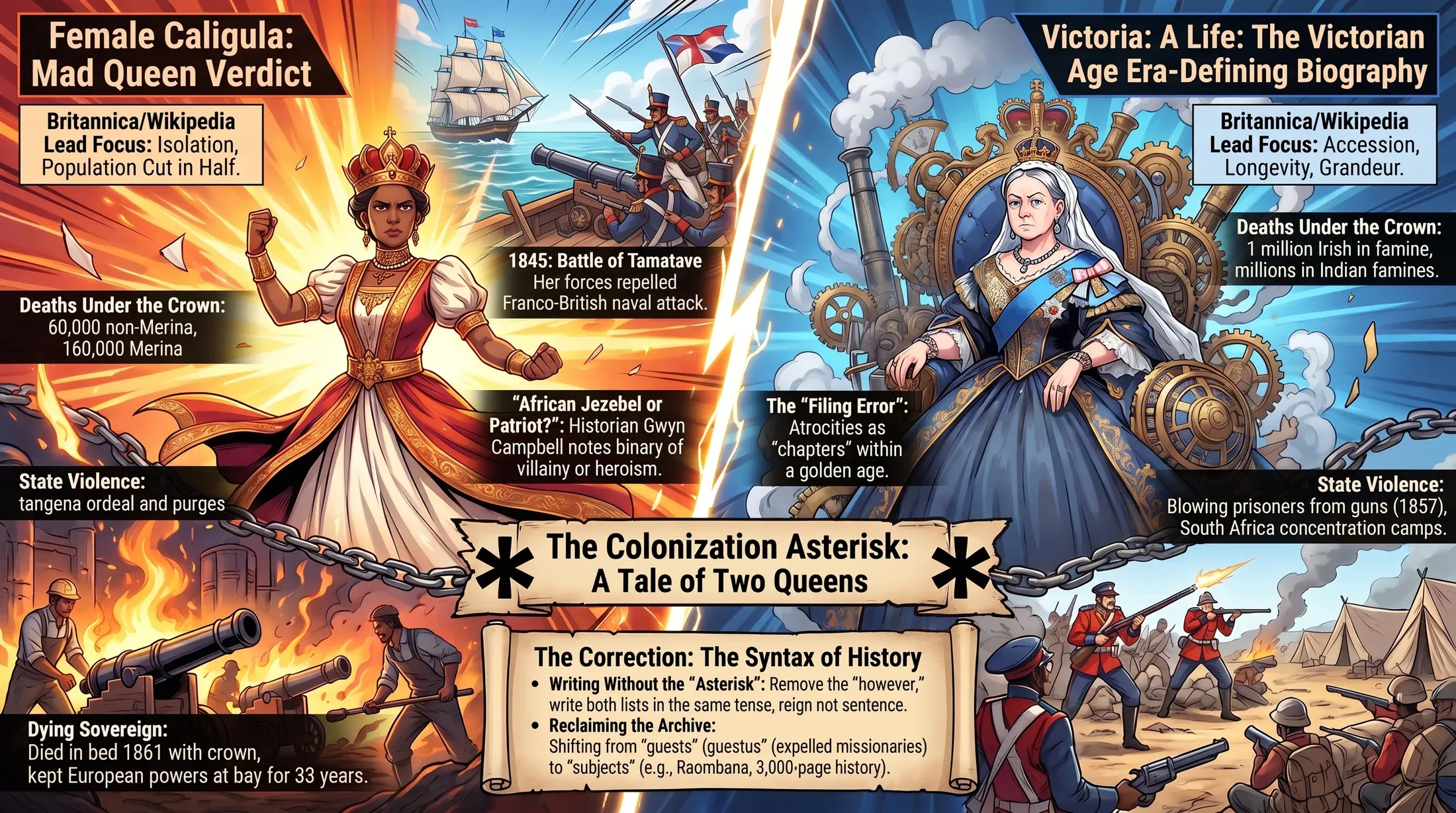
In 2005 an English house issued a book called Female Caligula: Ranavalona, the Mad Queen of Madagascar. Eight words. Two convictions. No trial. The woman in question ruled thirty-three years, threw a Franco-British landing back from her chief port, kept foundries that cast their own guns, and died in her own bed with the crown still on the house. Her British contemporary occupies the same shelf under titles that behave like furniture: Victoria R.I., Victoria: A Life.
That is the genre. Western memory does not, as a rule, deny that Africans governed. It files the governing under a structural however. Britannica’s first sentence on Afonso I of Kongo calls him “the first of a line of Portuguese vassal kings.” Wikipedia’s first paragraph on Ranavalona I offers isolation, the hunting of Christians, and a population cut in half. European colonial killing arrives later, in the paragraph reserved for men of their time. African state killing is the portrait. The coloniser’s pen did not have to invent the blood. It had only to decide which facts would become nouns and which would live out their lives in a dependent clause.
Afonso I, born Mvemba a Nzinga, held Kongo for three decades and left twenty-four letters to the kings of Portugal, whom he addressed as brothers. In 1526 he described the trade as it actually ran: freeborn people taken, nobles and his own kin seized, captives ironed and branded on the beach. “Our country is being completely depopulated.” He asked João III for priests and schoolmasters, “no other goods except wine and flour for the holy sacrament,” and for an end to the unlicensed export of slaves. He also kept slaves and sold prisoners of war. He was not writing toward a world without bondage. He was writing toward a world in which the trade ran under Kongo law, and toward a Christian court that still wanted Lisbon to treat him as a king. João III kept the ships coming and treated the missing as a local inconvenience in a large kingdom. Portugal remembers him as João the Pious. The protest file convicts the man who wrote it. Archival silence acquits everyone who kept no paper.
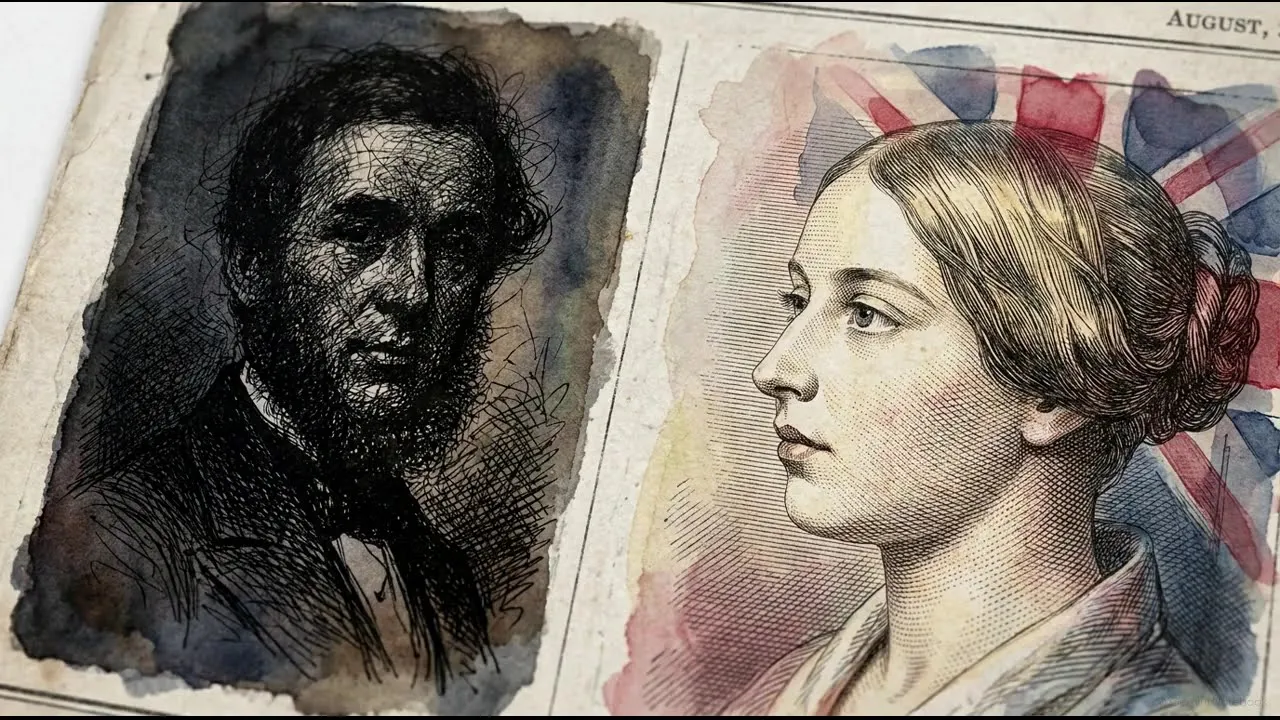
The nineteenth century perfected the habit. The pairing of Ranavalona with Victoria has a date. In 1837, months before Victoria took the throne, Malagasy envoys reached London to explain why the British alliance was finished. The Foreign Office answered by setting Ranavalona’s practices, which it called abhorrent, against the girl about to inherit an empire. Arianne Chernock has followed what the Victorian press then did with the contrast: it enlarged Ranavalona’s crimes in order to draw a domestic, Christian, imperial outline around its own sovereign, and it traced the cruelty to race, religion, and sex. William Ellis, whose History of Madagascar had already fixed her for English readers, wrote that Victoria’s power lay in example rather than in rule. Ranavalona answered the comparison herself. After Tamatave in 1845 she wrote to William Kelly, the British captain who had led the attack, that she had “as much right to nail her enemy’s head to the end of a pole” as Victoria had to send her prisoners into exile. Kelly gave the letter to a newspaper.
Victoria reigned inside a constitutional monarchy. Her ministers made Irish policy, Indian policy, Chinese policy, South African policy. Ranavalona commanded as an autocrat. The two are not being compared as rulers. What is being compared is the sentence each name is allowed to carry, in a memory now read from Antananarivo as well as from London.
She understood what the missionaries and the merchants were bringing. She kept Jean Laborde for a quarter of a century to run the works at Mantasoa and expelled the last Europeans only in 1857, after a coup built around a French concession. The decree of 1835 forbade Christianity to her subjects and left foreigners their worship: “I welcome all wisdom and all knowledge which are good for this country.” She used fanompoana, the tangena ordeal, military colonisation, and the purge. The wars were not only a wall against France and Britain. They built an inland empire on the defeat and enslavement of other Malagasy peoples: arsenal, corvée, and subject nations, the combination European monarchies file under state formation and leave in a quieter room.
The English-language dossier has a chain of custody. David Griffiths of the London Missionary Society, her friend of thirty years, left in 1835. William Ellis published History of Madagascar in London in 1838 without having set foot on the island; Gwyn Campbell has shown how much of it was Griffiths’s work. Freeman and Johns issued A Narrative of the Persecution of the Christians in Madagascar in 1840. Ida Pfeiffer, swept into the plot of 1857, left a memoir that appeared after her death in 1861. Ellis returned to the subject in The Martyr Church in 1870. Oliver compiled the pile in 1886. Laidler’s Female Caligula drew on it in 2005. Wikipedia cites Laidler for the black verdict and for the executions, and the lead still carries “Mad Monarch of Madagascar.” YouTube titles her the cruelest queen in history. No authentic portrait exists. Philippe Ramanakirahina painted the face that circulates, decades after her death, from a photograph of her niece. The photographer was Ellis.
The academic file has shifted. Reassessment began in the 1970s. Campbell showed that autarky was not a caprice: Radama I had already turned that way when the British alliance failed to replace the revenue lost with the slave export. In 2023 Campbell was still forced to pose the question as “African Jezebel or Patriot?” The title page has not moved.
Wikipedia’s lead still says that, by some estimates, her reign may have cut the population by as much as half. There was no census. The estimates are missionary guesses, reprinted until they hardened and began to look like facts. What can be said with more care is already grim enough. Campbell put some 60,000 non-Merina dead in the campaigns of Radama and Ranavalona between 1816 and 1853, and some 160,000 Merina soldiers dead between 1820 and 1853, many of them of malaria in the low country. Tangena killed in the low thousands a year. Fanompoana and scorched earth added deaths no one counted. The point is not that people did not die. The point is that a guess about collapse is permitted to stand as the first fact of a life.
Madagascar kept its own file. Raombana was born in 1809 into the Merina nobility, sent to England by Radama I at eleven, and came home at twenty speaking English and having lost his Malagasy. Ranavalona made him her secretary. He held the post until he died in 1855, and in those years he wrote, in secret and in English, several thousand pages on the kingdom from its origins through her reign, including the ordeal as he watched it given. Campbell reads him for the tangena. His heirs scattered the manuscript. Fragments reached print in 1900, in French, in a supplement of the colonial Journal officiel. Simon Ayache put the work back together, in Fianarantsoa and then Antananarivo, between 1976 and 1994. Raombana’s verdict on the reign is hard. Present-day Malagasy schoolbooks condemn it. Most Malagasy read her badly. The Malagasy who convict her were her subjects. The English who convicted her were her guests.
Victoria’s lead opens on accession, longevity, and an age. Under that name the Irish famine killed about a million while grain left the island under guard, and the Irish were her subjects. Indian famines killed millions while the export railways ran, and after 1858 the Indian dead were her subjects too. The South African camps of 1899–1902 killed some twenty-eight thousand Boers, most of them children, and at least fourteen thousand Black Africans. The empire has been charged. The brand has not. She remains the Grandmother of Europe. The atrocities are chapters. They are not the title.
Leopold II is the exception whose lead convicts him, from George Washington Williams in 1890 to the statues taken down in 2020, because his dead were concentrated, photographed, and tied to one man’s private colony rather than to a national golden age. Nor does the asterisk press with equal weight on every African ruler. Menelik II enters as the victor of Adwa. His expansion is filed as achievement; the violence waits in another article, because a defeat of Italy is a story the Western file already knows how to honour. Wikipedia files Afonso on power, conversion, and expansion, with the slave trade as a clause. Britannica files him as a vassal. Ranavalona’s file is isolation, ordeal, a woman’s autocracy, and sources written by the people she threw out: madness first, the polity afterwards.
The verdict left the page in 1855. Joseph Lambert held a charter that would give him first claim on the island’s resources once her son took the throne. He had the prince sign a letter in French, which the prince could not read, described to him as an account of the burdens the queen’s policies laid on her people. The letter asked Paris for troops. Paris wanted British consent first and did not get it. France took Antananarivo in 1895 and annexed the island in 1896. Gallieni’s report on the pacification, printed in 1900, states the programme he had been given: the destruction of Hova hegemony, the abasement of the conquering race, the coastal peoples cut away from their former masters. The empire that Radama and Ranavalona had built by conquest was named as the reason for conquering it. France kept every province. In 1897 colonial officers dug up her bones at Ambohimanga and moved them to Antananarivo, to take the sanctity out of the royal hill.
If the claim is about syntax, the life can be written without the caveat and without a halo.
Ranavalona I (c. 1778–1861) ruled Madagascar from 1828 until her death. She broke the British alliance inherited from Radama I, forbade Christianity among her subjects while leaving foreigners their worship, and used fanompoana and the tangena ordeal to take labour and enforce obedience. With Jean Laborde she built an industrial works at Mantasoa that cast cannon and muskets. Merina armies went on taking the island. In 1845 her forces threw back a joint Franco-British attack on Tamatave. In 1857, after a coup built around a French concession, she expelled the remaining Europeans. She died sovereign in the Rova of Antananarivo. No authentic portrait survives. Her secretary Raombana wrote the reign down in secret, in English. The English-language life was first written in London, by a man who had not been there, from the papers of the missions she expelled.
Victoria (1819–1901) was Queen of the United Kingdom of Great Britain and Ireland from 1837 and Empress of India from 1876. She reigned in a constitutional monarchy whose ministers directed policy. Her name names an age of industrial expansion and the largest empire of the century. In that reign the Irish famine killed about a million people while grain was exported; British forces put down the rising of 1857 in India, including by blowing prisoners from guns; two wars forced opium into China; famines in India killed millions while the export railways ran; and the South African camps killed some twenty-eight thousand Boers, most of them children, and more than fourteen thousand Black Africans. She died at Osborne House. The English-language life opens on accession, longevity, and grandeur.
Those paragraphs are inventories. They do not settle anything, and they do not need a however, because they are not dockets.
The cheap demand is to share the blood evenly: if leaders are defined by it, let the rule be the same for all. That is necessary and it is not enough. Symmetry still treats the life as a verdict. It only asks that Victoria stand in the same dock. Rehabilitation is the same form facing the other way: “patriot” in place of “Caligula,” and the substitution called justice.
The event sentences stay. The dead of tangena and of Skibbereen are not optional. Character verdicts do not get to be the shape of a life, whether the verdict is mad, cruelest, or grandmother of Europe. The coloniser needed the second. He did not invent the first. His asterisk was not analysis. It was a warrant that found the conquered guilty in advance, and France executed it in 1896.
The correction is not to put Victoria in Ranavalona’s place. It is to write both lists in the same tense, and to let the name mean the reign rather than the sentence. Ranavalona has been serving a sentence since 1861. Victoria has been serving as an age. That is the filing error. The sentence is what wants changing.
Encyclopedia leads as consulted, September 2026.
Get new pieces by email
Two to four essays a month. The list is never sold or shared, and you can unsubscribe in one click.
Comments
Comments are read before they appear. Disagreement is welcome; abuse is not.
No comments yet.