

The Carriers’ War
From Kariakoo to Thiaroye.
Two cities still carry the Carrier Corps in their names. The graves are being opened now; the ledger is still being settled.
We were taught to call it a World War. The Great War. The war to end all wars. From the red earth of Africa, from the scorched fields of India, from the occupied lands of the Arab world, the name has always rung hollow. To call it a “world” war is to accept a colonial premise: that the world is Europe.
Before 1914, the world was already at war. It was a war of pacification, of extraction, of famine and forced labor, waged by the very empires who would soon ask us to die for them. So what was 1914? A new chapter in an old story. Three cousins sat on three thrones1, and the system under those thrones, theirs and their rivals’ both, had swallowed almost the whole of the earth by the time they fell out.2 They conscripted the planet as extras in their dynastic drama because there was almost no part of it left that was not already on somebody’s ledger.
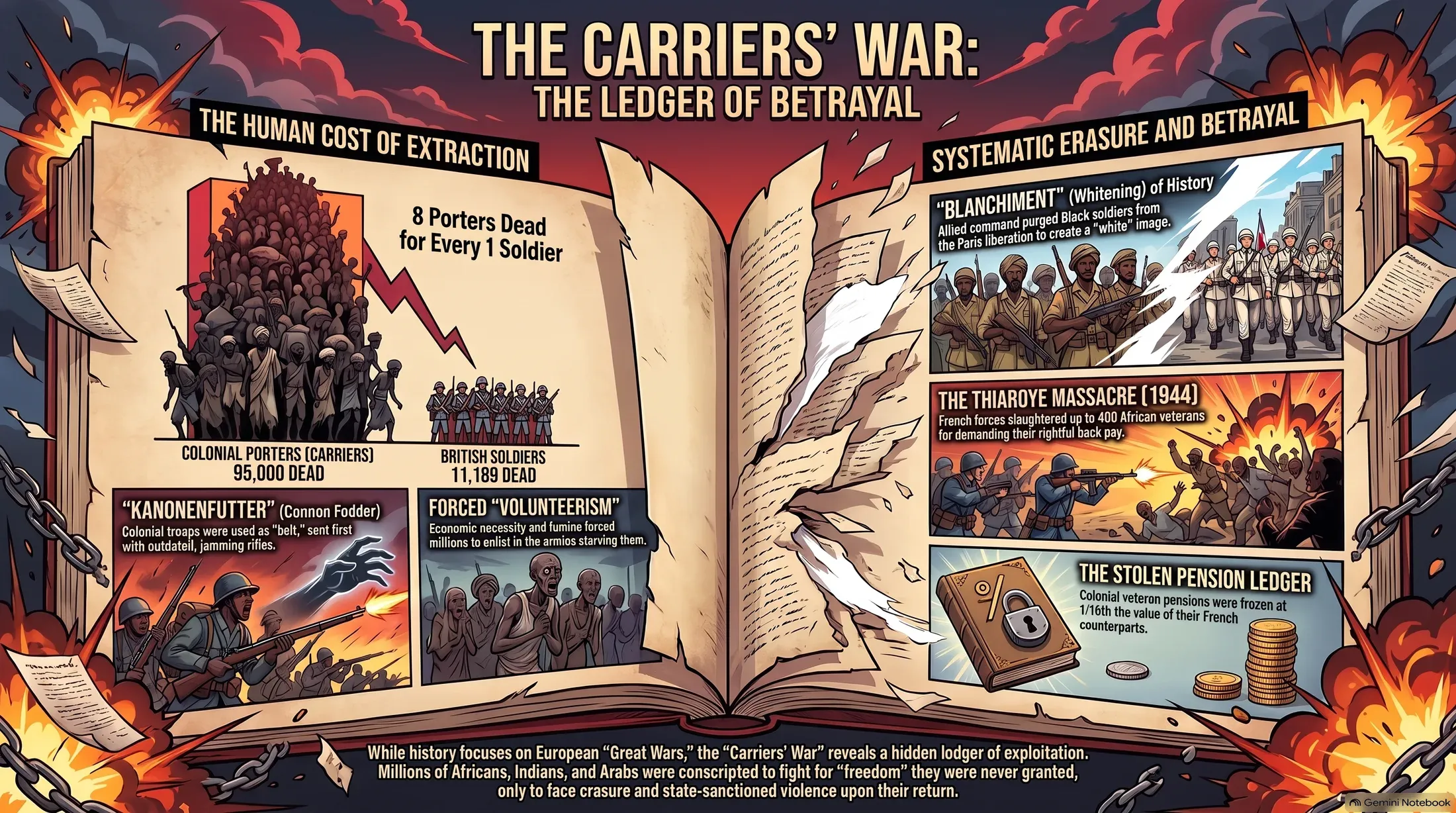
In East Africa the cities still carry the name of the men who carried that war.3 Kariakoo, in Dar es Salaam. Kariokor, in Nairobi. Carrier Corps, said by mouths that were never asked. So I do not call it the First World War; I call it the Carriers’ War. It is a name born from below, from the marrow of our bones. The campaign that raged across our lands killed more porters than soldiers, and it is the empire’s own count that says so: 11,189 British soldiers killed against 95,000 porters, more than eight carriers dead for every one in uniform.4 Men made to carry ammunition, food, and the wounded on their heads, barefoot, because boots were for soldiers, dying of disease, starvation, and exhaustion in a war that had nothing to do with them. The British did not ask them. They passed an ordinance so they would never have to.5 Historians who have gone back through the same files consider even that tally low, and the German sector was never counted at all.
And the carriers were only the labour. More than six hundred thousand soldiers from the African and Asian colonies of France and Britain fought in Europe itself, the French contingents raised under a doctrine a general had put in print in 1910: race guerrière, the “martial race” theory that Africans were naturally built for the violence Frenchmen should be spared.6 The Germans had a word for what that meant in practice, and it needs no translation: Kanonenfutter. Kanone is cannon. Futter is fodder, what goes in a trough.7 Whether Africans in French uniform were really being fed to the guns that way was argued in Germany’s own press through the war and into the 1920s, a real question that kept getting buried under a louder, uglier one about whether they should have been allowed to fight white men at all.8 The uglier argument won the newspapers. The word outlasted it.
The result of this Great War was a new great repartition. German Africa was handed out as “mandates” to the victors. Belgium, a nation whose own king had turned the Congo into a charnel house, was given Ruanda-Urundi, two kingdoms, by a League of Nations in which the kingdoms had no seat.9 The reward for taking Tabora was the right to plunder new territory. The faces of the masters changed. The administration did not.
Then came the sequel, the so-called Second World War. They call it a war against fascism, a war for freedom. Whose freedom? The colonized were told they had to fight the “master race” so that their own masters could remain in power. They did not ask. France had the statute. Britain had the closed door.
By then conscription had already been the law in French West Africa for a generation,10 and the law ran through the chiefs. A French administrator handed a village its quota, and the chief filled it, more than once with the younger sons and the weak, the ones nobody at home had the standing to protect.11 A man in Bamako or Ouagadougou was called up, not invited. For India, the empire did not even trouble itself to write a law.
They tell you Britain fought for liberty. The same Britain had presided over the deaths of tens of millions of Indians in famines that Mike Davis, reading the export accounts and the relief scales, called engineered: rations at Madras in 1877 set below what a working body needs to live, and defended by the colonial government on cost.12 It was still starving Bengal while it recruited: millions dead in 1943, the same years the recruiting stations filled.13 The empire’s century-old army swelled into the largest volunteer force the world had ever seen, and every man in it was entered in the record as a volunteer.14 To make the number, the recruiters lowered their own medical bar and signed the underweight, the anaemic, men whose bodies were already reporting what the famine years had done to their households. Some enlisted for family, for status, for a promise they believed. None of that changes what the door looked like from the other side. A historian who has gone through the wartime records has a name for what the posters called volunteering: economic necessity, wearing a uniform.15 Ask what such a man is escaping when he enlists in the army of the government starving him. France, with its own blood-soaked history in Africa, called upon its Tirailleurs Sénégalais to defend the “motherland.”
In this second war they took Africans, Indians, Arabs from their homes and sent us to the front lines. The French had a name for us on our papers: tirailleurs, the men sent out ahead of the line, who fire first and are fired on first. In Tunis, in the winter campaign of 1942 and 1943, what that meant still comes down through the grandmothers, because most of the men never spoke of it themselves and many did not live long enough to be asked: rifles older than the men holding them, rifles that jammed, working ones taken off the dead.16 The same kind of story is carried across the continent. In Senegal and Côte d’Ivoire historians eventually sat down with the old men and recorded them; the Tunisian version is still waiting for its historian. No clerk wrote it down either, and no clerk was ever going to take a complaint about a rifle from a man with no vote in the country whose uniform he wore. The clerks wrote down the rifles from the other end: designs from before the last war, with the newer equipment still a season away.17 On paper it was called infantry. From behind the rifle, it was bait. North Africans filled the rifle companies. The tanks, the guns, and the staff were mostly European. The old rifles went to the men in front, and the casualty lists in Tunisia and then in the Italian mountains fell where the doctrine had put us. We were dying anyway, from poverty, from colonial brutality. Dying for their cause would not be that awful, would it? They sacrificed the inconvenient to fight the inconvenient.
It is terrifying not because of what the enemy did, but because of what the “friend” did.
It is the story of the men who built Leclerc’s division: the tirailleurs who marched with him from Chad and swore at Kufra not to rest until the French flag flew over Strasbourg again, one of the few forces Free France had in the field in 1941, fighting under the same doctrine, race guerrière, one war on. The division was rebuilt in Morocco in 1943 around American tanks, and it was still a quarter African when the order arrived. When it came to Paris, they had to stop.
No Allied head of state had to sign the order; it came from Eisenhower’s own chief of staff, in a memo stamped confidential seven months before the liberation: it was more desirable, he wrote, for the division to consist of white personnel.18 De Gaulle had asked only that French troops lead the way into their own capital. The Americans and British granted it on that one condition. Some of the division’s own officers objected and were overruled. French command carried the purge out. It was the default position of the Allied command, the same reflex that kept the American army segregated while it fought. For the cameras, for the newsreels, the world was to see a certain image. The story had to be that we, the whites, saved ourselves. So the Black soldiers were taken out of the division before it sailed, and Frenchmen and Spanish Republicans put in their places. When the white men ran out, the gaps were filled with Syrians, Lebanese, and Algerians judged light enough to pass. The line was drawn not between French and colonial but at the colour of the skin. You will look a long time for a Black face in the photographs of the 25th of August. The oath was kept that November, when the division raised the flag over Strasbourg without the men who had sworn it.
One man got through anyway. Georges Dukson was twenty-two, from Gabon. He had enlisted at the start of the war, been taken prisoner in 1940, escaped, and lived underground in Paris until the city rose in August 1944, when he took command of a group of fighters in the 17th arrondissement. With a few revolvers and grenades they captured a German tank. On the 21st he was shot in the arm and kept fighting. At the victory parade on the 26th he stood a few feet from de Gaulle, arm in a sling, and the cameras that were supposed to find only white faces found his. An official marched him out of the parade. Days later he was arrested for dealing on the black market, shot while trying to escape, and died on the operating table. He was no saint, and the photograph does not care. It exists because he would not leave the frame.19
Kanonenfutter is the word German-language writers still reach for, decades on, when they describe what these men were to that army. That autumn the arithmetic reached the First Army too, and this time the army’s own files gave it a name: blanchiment, whitening. More than fifteen thousand West Africans who had landed in Provence and fought up the Rhône were pulled out of the line before winter, officially because of the cold, and replaced with Frenchmen from the Resistance.20 The Resistance men had no uniforms, so the tirailleurs handed over theirs. The Arabs were not pulled out of the cold. The North African divisions held the Vosges and Alsace all winter in the snow.
When France was free again, their thanks was betrayal. The men of 1940 had spent four years behind German wire in camps the Germans called Frontstalags, kept on French soil because Germany would not have them on German ground, and by the end the guards on that wire were French, because Vichy had agreed to do Germany’s guarding for it.21 Some had escaped and fought in the maquis. Their back pay was stolen. They were tucked away in transit camps to wait.
They had survived the Nazis. They could not survive the French state. When the day finally came for the French to “free” them and ship them home, these tirailleurs asked for what they were owed. They had been promised a quarter of it before they sailed and the rest when they landed. At Morlaix, more than three hundred refused to board without the quarter and were driven out of the town by gendarmes a week later.22 Four hundred more refused to go on at Casablanca. Some thirteen hundred landed at Dakar and were marched to a camp to wait for the rest.23 They asked again.
The response was not an apology. It was a massacre.
On 1 December 1944, at a camp called Thiaroye, outside Dakar, the French opened fire. Gendarmes, colonial troops, armoured cars, machine guns. The men had been assembled over a pay dispute. They called it a mutiny and court-martialled the survivors.24 Within days the war ministry put out a circular saying every one of these men had already been paid in full.25 They covered it up for decades. Only a few were shot, they said. The general’s report of 5 December exists in two copies, in two different archives, and they do not agree on how many died. One says double the other.26 The historians Senegal finally sent into the files put the most credible documentary estimate at ten times the official count: three hundred to four hundred against thirty-five.27 That figure is a reading of the paper trail, of men who vanish from the movement logs. It is not yet a count of graves. It took eighty years for a French president to say the word massacre, and he said it in a letter.28 The bones and the bullets are coming out of the cemetery at Thiaroye now. As of 2026 the first trenches have given up a handful of bodies. Dakar is still asking Paris for the files.
This was no accident. The word Senegal’s own commission used for it is premeditated.29 The armoured cars were in position before the men were assembled.
The colonizers could not allow these men, hardened by war and trained in modern warfare, to come home as they were. They were a threat to the colonial project. They had seen that the white man was not invincible, that he could bleed, and that he could be defeated.
They had not expected them to come home with a ledger of their own. They came home with one, and at Thiaroye they were killed for it.
The price went on being collected. As each colony became independent, France froze the pensions of the old men who had done its fighting, while a Frenchman who had stood in the same hole on the Garigliano kept his pension climbing with the cost of living for the rest of his life.30 It took until the next century to undo it, for the few who were still alive to notice. The state never needed to win that argument, only to wait.
The name I am asking you to use is no emblem: it is already on the maps of two cities, and it is a camp outside Dakar whose cemetery is still being opened. Call it the Carriers’ War. Then look at who is missing from the photograph of the 25th of August, and at the two folders in Aix and Vincennes that cannot agree on how many men the French state killed for asking to be paid.
Notes
30
-
Wilhelm II of Germany, George V of Britain, and Nicholas II of Russia. Wilhelm and George were first cousins, grandsons of Queen Victoria. George and Nicholas were first cousins through their Danish mothers. Nicholas’s wife was Victoria’s granddaughter, and he and Wilhelm were more distant cousins. They wrote to each other as Willy, Georgie, and Nicky. ↩
-
By 1914, European empires controlled 84.4 percent of the earth’s land surface, up from 35 percent in 1800. David Stevenson, 1914-1918: The History of the First World War, citing Philip Hoffman’s calculation. The figure measures formal empire, not informal control. ↩
-
Geoffrey Hodges retitled his history of the British Carrier Corps Kariakor after the toponym it left behind. ↩
-
11,189 British soldiers killed against 95,000 porters who died in the East African campaign. The ratio in the text uses that pairing, not all imperial combatant deaths in the theatre, which would lower the multiple without changing its shape. The Belgian sector shows the same imbalance: 2,620 soldiers against 15,650 porters. Historians working from the same files treat even the British porter tally as incomplete. ↩
-
The Native Followers Recruitment Ordinance, 1915, British East Africa, made carrier service compulsory. ↩
-
General Charles Mangin argued this openly in a 1910 book, La Force Noire. ↩
-
Kanone: cannon. Futter: fodder, feed. ↩
-
Christian Koller, Von Wilden aller Rassen niedergemetzelt (2001), documents the German-language debate over colonial troops in Europe between 1914 and 1930; his study counts more than 600,000 non-white soldiers from the French and British colonies in the European theatre of the First World War. It existed alongside, and was often overwhelmed by, a racist campaign against the mere presence of Black soldiers in Europe. By the Nazi era, that second current fed the forced sterilization of at least 385 mixed-race “Rhineland” children in 1937. ↩
-
Conferred as a League of Nations Class B Mandate under Article 22 of the Covenant, 20 July 1922, following the Force Publique’s capture of Tabora on 19 September 1916 and Germany’s renunciation of its colonies under Article 119 of the Treaty of Versailles. ↩
-
The AOF conscription law dates to 1919. ↩
-
Myron Echenberg, Colonial Conscripts: The Tirailleurs Sénégalais in French West Africa, 1857-1960 (1991), on quota recruitment through chiefs. ↩
-
Mike Davis, Late Victorian Holocausts (2001): between 12 and 29 million famine deaths across British India, 1876-1902, including relief rations at Madras in 1877 set below subsistence for hard labour and defended by the colonial government on cost. Davis’s range is the high published estimate and is disputed by economic historians who weight drought and market integration more heavily than policy. The Madras ration scale is not in dispute. ↩
-
The 1943 Bengal famine killed close to three million. ↩
-
The Indian Army grew to roughly 2.5 million men by the war’s end. No conscription statute was ever introduced in British India. ↩
-
Indivar Kamtekar, “A Different War Dance: State and Class in India 1939-1945,” Past & Present (2002). ↩
-
Carried as oral history in Tunisian families whose grandfathers served in the 1942-43 Tunisian campaign. Not yet matched to a written archival source. For the West African counterparts that were recorded: Joe Lunn, Memoirs of the Maelstrom: A Senegalese Oral History of the First World War (1999); Nancy Lawler, Soldiers of Misfortune: Ivoirien Tirailleurs of World War II (1992). ↩
-
The Armée d’Afrique’s rifles were of pre-1914 designs, the Lebel and the Berthier. The 1940 armistice capped its rearmament, and American equipment began arriving only after the January 1943 Anfa agreement. ↩
-
Eisenhower’s chief of staff, Major General Walter Bedell Smith, wrote in a memo stamped confidential, January 1944: “It is more desirable that the division mentioned above consist of white personnel.” The BBC uncovered the document in 2009 (reporter Mike Thomson). The 2e DB, roughly a quarter “native,” was chosen because it was the only French division that could be brought close to entirely white. Its Black African soldiers were removed before it shipped to England in the spring of 1944, replaced by white Frenchmen and several hundred Spanish Republican exiles. When white replacements ran short, Syrians, Lebanese, and lighter-skinned Algerians were used, and estimates of the Maghrebi soldiers still in the division at Paris run from about 1,300 (Muracciole) to 3,600. One Black soldier of the division entered the city: Corporal Claude Mademba Sy, machine-gunner on the tank Pantagruel of the Régiment de marche du Tchad, who held French citizenship, unlike the men removed. The purge went through over the objections of some of the division’s own officers; French command carried it out. The historian Jean-François Muracciole judges the operation more racial than colonial. No evidence places Roosevelt personally in this chain. He is on record maintaining segregation in the US armed forces generally, and separately approved a plan, opposed by Eisenhower, for direct Allied military government of liberated France rather than immediate transfer to de Gaulle, a political dispute distinct from this one. ↩
-
Georges Dukson, born in Port-Gentil, French Equatorial Africa, now Gabon. His father had served France in the First World War. Enlisted at the outbreak of war, trained at Libreville, went to France as a sergeant, was captured in 1940 and escaped. He joined the Paris uprising of August 1944 and was nicknamed “the Lion of the 17th” for the arrondissement he fought in; wounded 21 August. Photographed beside de Gaulle at the 26 August parade before being removed from it. Arrested days later for black-market dealing, shot while attempting to escape custody, and died on the operating table. Gary Younge, “The Lion of the 17th,” British Academy (2024) and FT Magazine (August 2024); Matthew Cobb, “The lost lion of Paris.” ↩
-
More than 15,000 tirailleurs withdrawn from the 1re Armée in the Belfort sector in autumn 1944 and sent to the south. The army’s own files called it “blanchiment” or “blanchissement.” Claire Miot, “Le retrait des tirailleurs sénégalais de la Première Armée française en 1944,” Vingtième Siècle, no. 125 (2015). On the surrender of uniforms and equipment to FFI replacements: Julien Fargettas, Les tirailleurs sénégalais (2012); Jean-Baptiste Dusséaux, Le Blanchiment des troupes coloniales, France 3, 2015. ↩
-
The Frontstalags were set up in occupied France in the summer of 1940 for colonial prisoners, whom Germany would not hold on its own soil out of what it called fear of racial contagion. Some 69,000 colonial prisoners passed through them, including about 15,800 West Africans. From 1943 French personnel guarded the camps under an arrangement with Vichy. Armelle Mabon, Prisonniers de guerre “indigènes” (2010; reissued 2019). ↩
-
A French Red Cross document found by Armelle Mabon records 315 men refusing to board the Circassia at Morlaix on 4 November 1944 because the quarter of their arrears due before embarkation had not been paid. On 11 November a gendarmerie operation cleared them from the town, with shots fired according to Mabon. They were held at Trévé and then Guingamp until January 1945. ↩
-
About 1,950 men were assembled at Morlaix from the transit centres at Rennes, Versailles, and La Flèche. Around 1,635 sailed on the Circassia on 5 November. Some 400 refused to continue at the Casablanca stop. Roughly 1,280 to 1,300 landed at Dakar on 21 November 1944. The army’s own figures for each stage do not agree with one another, and the gaps are part of the dispute over the death toll. ↩
-
Thirty-four survivors were court-martialled in March 1945. ↩
-
War ministry circular, 4 December 1944, falsely claiming full payment had already been made. ↩
-
General Dagnan’s report of 5 December 1944 survives in two copies: the copy in the Overseas Archives at Aix-en-Provence records 35 dead, the copy at Vincennes 70. The initial report of 2 December had recorded 24 killed outright and 45 wounded, 11 of whom later died. ↩
-
The 2025 Senegalese government commission report, led by historian Mamadou Diouf and presented in October 2025, puts the most credible documentary estimate at 300 to 400 against an official count of 35. The commission itself states that a definitive total is still difficult to establish, and that more than 400 men vanish from the movement logs. Archaeological work at the Thiaroye military cemetery, underway into 2026, had recovered seven bodies by late 2025, among them one skeleton with a bullet at the left side of the chest and another with iron chains at both ankles. Ballistic and DNA analysis remained outstanding. Senegal has accused France of withholding further archival material. ↩
-
President Macron used the word “massacre” in a letter dated 28 November 2024. ↩
-
The Diouf commission’s finding, October 2025. ↩
-
Cristallisation: once their countries became independent, veterans from former French territories had their pensions converted into fixed, non-indexed allowances. Article 71 of the finance law of 26 December 1959 applied it to Tunisia, Morocco, and most of sub-Saharan Africa from 1961; article 26 of the supplementary finance law of 3 August 1981 applied it retroactively to Algerians; Senegal, Chad, Gabon, and the Central African Republic were brought in by a 1979 law with effect from 1975. By 2000 a pension point was worth 1.18 euros in Tunisia and Morocco against 12.48 euros for a French veteran. The Conseil constitutionnel struck the regime down on 28 May 2010 (decision 2010-1 QPC), with full alignment from 1 January 2011. ↩
Get new pieces by email
Two to four essays a month. The list is never sold or shared, and you can unsubscribe in one click.
Comments
Comments are read before they appear. Disagreement is welcome; abuse is not.
No comments yet.