

On the Name
/de'sif'R/: decipher the code, de-null the verdict, descramble the signal.
Sifr is Arabic for zero, and the root of cipher. One word, two European inheritances, and three operations this publication runs against what that word did to Africa’s record. Two to four essays a month, free to read.
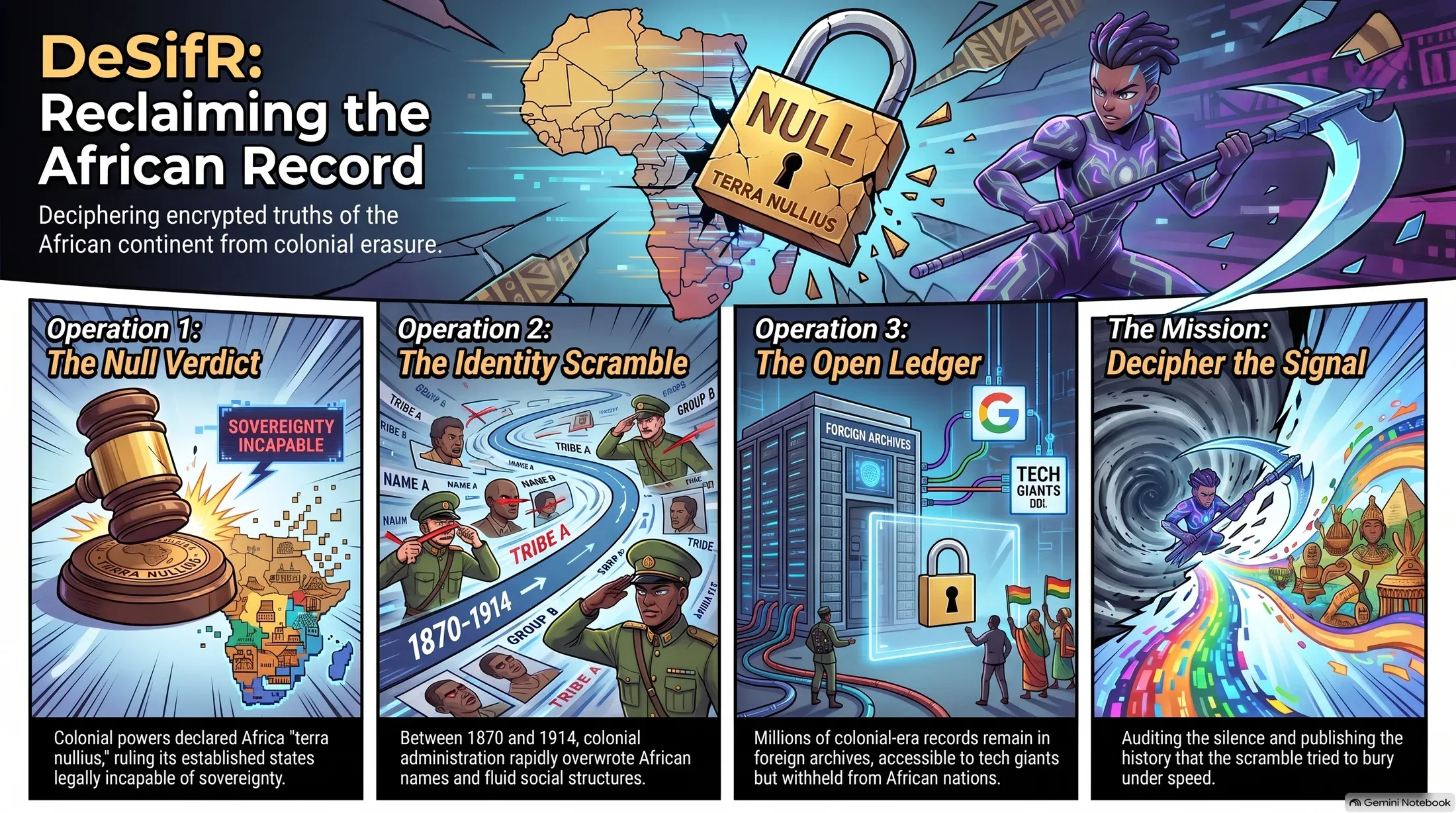
Sifr. Arabic for zero. Also the root of “cipher.” One word, two European inheritances: the digit that signifies nothing, and the code that hides something. DE-0, read /de’sif’R/, writes the zero where the word sits, and runs both operations at once. It deciphers. It de-nulls.
Not the arithmetic. Two operations, run on two different tenses of the same continent. Nulling worked on the past: it ruled that nothing of value existed there before Europe arrived, emptied of sovereignty in law, emptied of history in scholarship, rebranded as a void in the public record. Scrambling worked on the present tense of the 1880s and 1890s, the actual invasion, the actual division of the continent into colonies, carried out at a speed and with a carelessness that European historians named accurately while it was still happening. They called it, without irony, the Scramble.
The law came first. The General Act of the Berlin Conference, 1884-85, partitioned the continent under a doctrine called “effective occupation.” It did not require any European power to prove African land was unclaimed. It required only that existing African polities, the Sokoto Caliphate, the Asante Empire, the Kingdom of Kongo, Buganda, dozens of others with standing armies, treasuries, and diplomatic relations older than most of the states dividing them, be treated as legally incapable of holding sovereign title. Functionally, this is the same operation later formalized as terra nullius elsewhere in the empire: land is null not because it is empty, but because the people on it are declared unqualified to own it.
Scholarship followed. Georg Hegel closed the continent out of History itself in his Lectures on the Philosophy of History, calling it “the unhistorical, undeveloped spirit, still involved in the conditions of mere nature.” Hugh Trevor-Roper, Regius Professor of History at Oxford, restated the ruling in 1963 with less philosophy and more contempt, dismissing African history to his students as “the unrewarding gyrations of barbarous tribes in picturesque but irrelevant parts of the globe.” Two chairs of history, a century apart, filed the same verdict: null.
Branding closed the loop. “The Dark Continent” was not a description, it was marketing, popularized by Henry Morton Stanley’s 1878 travelogue of that title and sold to a European public that needed a reason to fund the partition already underway. The label implied a continent unmapped and unknown. It was neither. Arab geographers had documented the interior for centuries. Swahili coast traders ran commercial networks deep into the continent’s interior. African states kept their own chronicles, treaties, and trade accounts. The darkness was manufactured on the reading end, not the writing end.
The scramble that gave the word its name started in the Congo basin specifically. King Leopold II of Belgium claimed the territory in 1884 as his personal property, not Belgium’s, and the rush by France, Britain, Portugal, and Germany to stake competing claims before he could consolidate it is what forced the other powers to convene the Berlin Conference, to regulate a race that had already started without them. From that point the pace was not settlement, it was extraction under deadline. In 1870 the interior of the continent was governed by African states, kingdoms, and confederations running their own administrations. By 1914, every territory on the continent had been claimed by a European power except Ethiopia, which had defeated an Italian invasion force at Adwa in 1896, and Liberia. Thirty years, from an open political map to near-total partition. That speed is what “scramble” names. It is not a metaphor DE-0 imported into the historical record. It is the word the historical record already uses.
Nulling denied that anything existed before 1880. Scrambling did not deny, it broke what existed while manufacturing new record at speed, and three of those breaks are still open.
The first was cartographic. Léopoldville, Élisabethville, Stanleyville, Coquilhatville: colonial administrators overwrote existing place names with the names of Belgian kings and company agents, and the overwrite became the only name recorded in the shipping manifests, court records, and correspondence that make up the archive. Kinshasa, Lubumbashi, Kisangani, and Mbandaka reclaimed their names after independence. The colonial paperwork did not update itself. Anyone working that archive now holds two toponymies at once and translates between them, a decoding step built into the act of reading, not incidental to it.
The second was administrative. Belgian rule governed through what it certified as “customary law,” enforced by chiefs the administration recognized as legitimate. That certification did not discover a pre-existing custom. It manufactured one: fluid, overlapping, negotiated precolonial authority got frozen into fixed ethnic categories, pinned to territories, and administered as though the boundaries had always been singular and permanent. Mahmood Mamdani has documented this mechanism, the colonial invention of “the customary,” across Belgian and British Africa. The categories survived independence, inherited by postcolonial states as indigenous fact rather than administrative convenience, and versions of that manufactured boundary line are still being fought over in the eastern Congo now.
The third scramble is current and material, not metaphorical. Somewhere between three and four million geological and natural-resource survey documents from colonial Congo, the record of the subsoil the Belgian administration mapped and mined, sit in the archive of the AfricaMuseum in Tervuren, outside Brussels. Kinshasa asked for them back during the independence negotiations in 1960. As of February 2026, sixty-five years later, the dispute has a new party: KoBold Metals, a mineral-exploration firm backed by Bill Gates and Jeff Bezos, struck a deal with the Congolese government for access to that same archive to prospect the country’s cobalt and coltan. Belgium is now negotiating who gets to digitize its own colonial record first, citing the documents’ status as Belgian federal property. The signal was never deleted. It changed custodians, and the newest bidder for access is not the country the data describes.
DE-0 names three operations against that record: decipher the code, reverse the null verdict, descramble the signal. The work is a reading exercise. Set the paper record against the oral one, locate the discrepancy, publish the discrepancy instead of resolving it into something comfortable. Where the colonial record says “no history,” audit the record. Where the museum label says “acquired,” establish who was standing there when it left. Where an archive requires a foreign institution’s permission to be read by the people it describes, name that as the third scramble.
The standard is meant to run in both directions. A charge against a European institution needs a named exhibit. A claim for an African polity needs the same. Colonial records are read against themselves, and oral testimony enters marked as oral testimony. That is the intent. Where a published essay falls short of it, the correction goes on the record, named and dated.
The room where that record is read is now shared. The great-grandchildren of the conscripted and the great-grandchildren of the conscriptors sit in the same lecture halls, read the same syllabus, and inherit the same museums and archives. Kant is on that syllabus. So is his 1775 essay “Of the Different Human Races,” which ranked humanity by skin and climate and placed Africans below Europeans in capacity, a ranking he repeated in his lectures on physical geography for decades. Teaching the categorical imperative without the essay does not neutralise the essay. It leaves the ranking unexamined in a curriculum that examines everything else, which is the null verdict again, filed by omission instead of by contempt. The same applies to every author whose ranking of peoples has been dropped from the reading list rather than read.
That is the subject here. Not the size of Europe’s guilt, and not the merit of any continent measured against another. The subject is how a shared record gets told in a shared room without one party’s version standing as the default. The gap between what was written and what happened was never empty. It was encrypted, dispersed, and locked in custody, and it is still being fought over in real time. Ignoring it has a record of its own: sixty-five years of unanswered requests from Kinshasa, and a syllabus that still teaches the ranking by leaving it out.
Get new pieces by email
Two to four essays a month. The list is never sold or shared, and you can unsubscribe in one click.
Comments
Comments are read before they appear. Disagreement is welcome; abuse is not.
No comments yet.