Ethnogenesis Is Not a European Privilege
Arab genealogy and Amazigh purism are the same test, run from opposite ends.
Gulf genealogy ranks Tunisians as insufficiently Arab; Amazigh purism answers with a bloodline test of its own. Alsace shows how Europe actually grants an ethnonym, by soil and time, not descent, and Ahmad Bey abolished slavery by decree in 1846, two years before France did. Tunisian is not a compromise between Arab and Amazigh; it is the name of everyone who stayed.
An orthodoxy has taken root in Tunisia: that “Berber” is a colonial slur to be replaced everywhere by “Amazigh,” and that authentic indigeneity belongs only to those who kept an unmixed linguistic lineage in isolation. It began as a correction. The independent state had written the Amazigh out of the national account, and reclaiming an endonym asserted a dignity the state denied. The correction imported a standard of its own: a purity test.
The first erasure came from Arab nationalism. Its logic was absorption: everyone was Arab, so particularity was noise.1 Tunisia’s constitution of 1959 wrote the project into law: Arabic the language of the state, the Republic part of a “Grand Arab Maghreb,” the people faithful to their “belonging to the Arab family.”2 No other people is on the page. Absorption worked as a flood, not a gate.
After 1967 the project collapsed, and each Gulf war cut away a part of it. The Gulf monarchies paid for Iraq’s war against Iran and left the Baathist state in their debt. In 1990 Iraq invaded Kuwait, and the Arab League split: twelve of twenty-one members voted to condemn Iraq and commit troops under American command, while Tunisia, then host of the League, stayed away, and the headquarters left Tunis for Cairo.3 In 2003 the American-led invasion removed the Baathist state in Baghdad.4 The centre of gravity moved to the Gulf, with its oil, its satellite channels, and, after 2011, its money for clients in the weakened states.5 The one leader who had tied Arabness to Africa, Gaddafi, launched the African Union at Sirte in 1999 and was killed in 2011; after him one project consolidated, and it was the Gulf’s.6 The word moved with the money, from inclusive to tribal, from secular to Islamist, from Baghdad to Riyadh, until “Arab” named a genealogy of peninsular descent and literalist religion, with Tunisia at the bottom.7 The hierarchy does not bind its authors. The ruling families of Kuwait and Bahrain are cousins from one confederation, the Bani Utbah; they speak one Arabic and rule two nations.8 If one lineage can make two peoples, a population on its own soil since antiquity can manage one.
The constitutions written after 2011 took up the word after it had changed owners. The text of 2022 makes Tunisia “part of the Arab nation” and binds its schools to an “Arab and Islamic identity” and to the “generalisation” of Arabic.9 The constitution of 1959 had spoken of a family, and the European Union still speaks of “the peoples of Europe,” in the plural.10 A union of peoples leaves each its name; a single nation takes it. The Arab of 1959 was a project Tunisia could join. The Arab of 2022 is a rank others assign. Many Tunisians still hold the first. The text signs them into the second.
The same text affirms belonging to “the African continent, which bears the historic name of our dear homeland,” and on that point it is right: the Romans called this land Africa, the Arabs kept the name as Ifrīqiya for a thousand years, and the continent took it from here.11 Six months later the presidency called a “purely African” Tunisia a threat.12 The country that named Africa, officially frightened of becoming African. The fear cannot be of Islam or of Arabic. The migrants the statement named came largely from West Africa: from Guinea and Mali, where most people are Muslims, and from Côte d’Ivoire, where Islam is the largest faith, countries whose languages, Fula and Mandinka among them, have been written in Arabic script for centuries.13 A Muslim who prays in Arabic cannot threaten an “affiliation to the Arab and Islamic nations.” What the statement guarded was drawn at colour, and a line drawn at colour is a race, not a faith or a language. Tunisians marched against it in Tunis four days later.14
Against that hierarchy the Amazigh revival was rational. If “Arab” meant clientage to someone else’s genealogy, the obvious move was to claim a history older than the Arab conquest. Part of the movement then accepted the terms of the insult. The Gulf held that authenticity required pure blood and pure language; the purist reply held the same for indigeneity. A Tunisian who speaks Tunisian is now refused twice: by the Gulf as an insufficient Arab, by the essentialist as an Arabised stranger. The gate remains. Only the gatekeeper changes.
The case against “Berber” rests on its origin: Greek barbaroi, Latin barbari, an outsider’s word for unintelligible speech. Tunisia domesticated the word long ago. Ibn Khaldun, born in Tunis, set al-Barbar in the title of his history beside the Arabs and the non-Arabs and wrote of a nation of state-builders, jurists, and dynasts.15 To discard it because a Roman magistrate meant an insult cuts Tunisians off from their own archive. That is no argument for imposing it on those who still hear barbara, the Arabic verb for talking gibberish. The sting is real. So is the archive.
“Berber” never named the whole country. The early Arabic accounts of the conquest distinguish the Rūm of the Byzantine garrison, the Afāriqa of the Latin-speaking towns, and the Barbar of the countryside.16 Amazigh is part of that Berber; Berber is not only Amazigh. To collapse the second into the first is a second erasure: the mixed majority stops being Berber evolving and becomes merely “Arabised.” The mountains kept the oldest stratum longest. Chenini, Matmata, Douiret, and Tamezret preserved Tamazight because they lay outside the regular reach of administration and trade. That survival is precious and must be protected in schools, place-names, and public speech, not staged as folklore. It is not the whole of Tunisian history. The farmer near Roman Dougga whose family spoke African Latin and prayed in a basilica was not squatting on his own land. He was the country. A purity test turns adaptation into betrayal and so disqualifies the majority it claims to defend.
Where a country has not written its own continuity, someone else writes it. Europe wrote its own as an evolution: its peoples were made, not found. The French are not asked to dissolve into “Latins” because they speak a Romance language; “French” itself once named one Germanic confederation, and an ethnonym usually begins narrower than the people it comes to name. A faith names no people either: Malta is Catholic and Maltese, Denmark Lutheran and Danish.17 Nor does Islam require Arabness. Most Muslims are not Arabs; Persia and the Malay world kept their languages and their names while becoming among the most thoroughly Muslim societies on earth, and historians of conversion treat Islamisation and Arabisation as two processes.18 Tunisia’s constitution writes them as one. The genealogy of a grammar is not an ethnicity. Conflating the two is a racial rule: ethnogenesis as a European privilege, Tunisian mixture as affiliation to a bloc.
Alsace shows the order in which Europe grants the name. Its population spoke Alemannic through four changes of border between 1871 and 1945. Germany claimed them by the family of the grammar. France answered with will and soil, and sorted by grandparents. From December 1918 the A card made French anyone whose parents and grandparents were born there before 1870 or in France, while the kitchen was still Alemannic.19 The language followed the name: by 2022 three per cent of Alsatians aged eighteen and under spoke the dialect.20 Where a language does not follow, a state can keep it alive: Schleswig-Holstein gave North Frisian its own law in 2004, and its constitution entitles the Frisian ethnic group to protection and support.21 Tamazight is owed no less. The grandson of a Polish miner in the Ruhr became German with his name still Nowak.22 Europe gave the Alsatians the name before their language changed and let Nowak in with his own. That is the privilege.
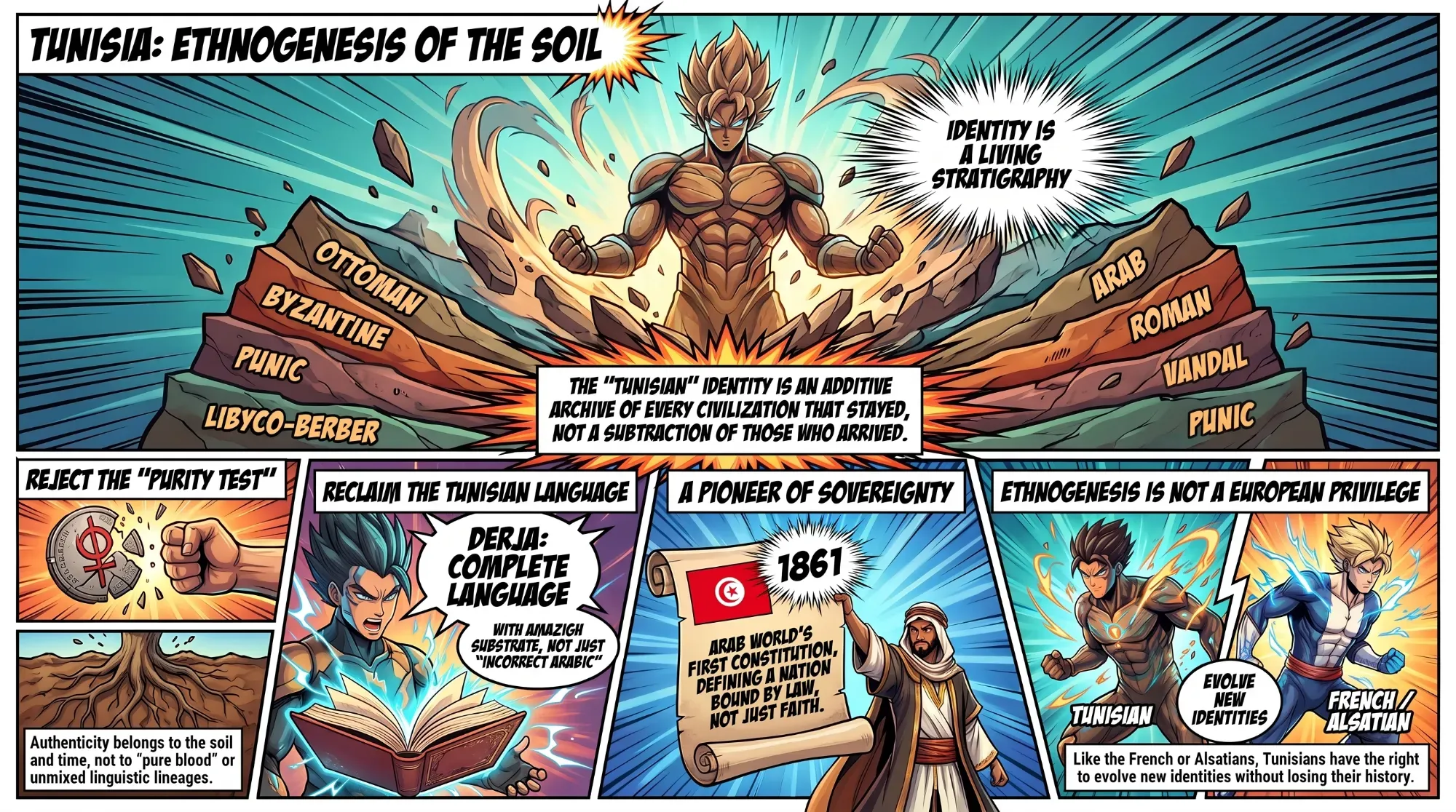
Tunisia drew its own lines long before its constitutions named it Arab, on the map and in the law. Tunis and Algiers fixed the western frontier by treaty in 1628, two and a half centuries before the protectorate, which settles on the ground the objection that France drew the borders.23 Ahmad Bey abolished slavery by decree on 23 January 1846, two years before France.24 The Fundamental Pact of 10 September 1857 made every inhabitant of the Regency equal before the law and the tax, Muslim or not; consuls pressed for it after the execution of Batto Sfez, and it followed an Ottoman model.25 The Regency made it its own. Its constitution of 26 April 1861, the first written in the Arab world, bound every official by oath to the laws that flow from the Pact, and in 1920 the national movement took its name from that legal tradition: Destour, the “constitution,” whose restoration it demanded.26 The line in the law was the soil, not the faith or the colour.
Tunisia’s identity is stratified: Libyco-Berber agriculture, Punic shipping, Roman engineering, Vandal seapower, Byzantine administration, Arab-Islamic statecraft, Andalusi arrival, Ottoman rule, each laid on the same ground. Rulers came with armies; the people already there stayed, paid the taxes, and built the monuments. Most newcomers married in. Some did not, and their descendants belong here no less: the Arab lineage that kept its genealogy, the family of Turkish origin that kept its name. “Berber” names the population that stayed; “Tunisian” names the same population with everyone it received, Arab and Ottoman included, Ibn Khaldun’s al-Barbar carried one step further. Tunisian is an ethnonym: not the civic remainder left when the purity tests cancel out, not a mosaic set side by side, not only the name of a state. Citizenship is the door; the ethnonym is what a family becomes after generations on this soil. The test is time here: not blood, as the Gulf asks; not an unmixed tongue, as the purist asks; not a name or a faith, as Europe asks. The name covers the highland Tamazight speaker, the Punic merchant of Sousse, the Latin theologian of Carthage, the Arab jurist and the rabbi of Kairouan, the Ottoman bey, the Black Tunisian whose belonging predates the presidency’s fear of a “purely African” Tunisia, and the writer who publishes in Tunisian. None of them is subtracted.
The hyphen, Tunisian and Arab, is no obstacle, any more than Nowak was in the Ruhr. What cannot stand is the promotion of a domestic affiliation into the only nation the law assigns the country. That affiliation is a strand. The legal name is the flood. A state cannot tell its minorities that ethnicity is divisive and then root children, by constitution, in one ethnicity and one creed. Either both are political, or neither is.
Almost everyone in Tunisia speaks the language of the house and the market; almost no one is allowed to call it a language where the law is written. Arabic ranks its registers: al-fuṣḥā, “the most eloquent”; derja, the speech of circulation, placed below legitimacy before anyone has listened. The ranking is a value judgment, not a finding. Tunisian is a complete language, with an Amazigh substrate in sound, syntax, and vocabulary.27 German made the opposite choice. Deutsch began as diutisc, “of the people,” the vernacular set against Latin; the speech of the commons became the name of the nation.28 Arabic kept the same idea as a demotion. The language already has another name in practice: Tunisian. Taoufik Ben Brik’s Kelb ben Kelb (2013), written in it after 2011, was among the most requested Tunisian books of that year at two Tunis bookshops.29 The Derja Association, launched in 2017, awards annual prizes for writing in it, and its members call the language Tunisian, to the point of debating whether to drop derja from their own name.30 Maltese, descended from an Arabic close to Tunisian, is the national language of Malta because a people were allowed to write what they spoke.31 Grammar did not forbid it. A rank forbade it here. People who are not allowed to think in the language they live in do not become Arabs. They become unfinished.
Tunisians who speak Tunisian are not speaking incorrect Arabic. They speak the language of the population that stayed, whose mountains kept Tamazight, and of everyone it received. Tunisian is not a compromise between Arab and Amazigh. It is the ethnic name of the people that formed on this soil.
Notes
31
-
Adeed Dawisha, Arab Nationalism in the Twentieth Century: From Triumph to Despair (Princeton: Princeton University Press, 2003). ↩
-
Constitution of 1 June 1959, preamble and arts. 1–2, Journal officiel de la République tunisienne (JORT) no. 30, 1 June 1959, published in Arabic only; French text as issued by the Imprimerie officielle. Article 2: “La République tunisienne constitue une partie du Grand Maghreb Arabe, à l’unité duquel elle oeuvre dans le cadre de l’intérêt commun.” The preamble: “son appartenance à la famille arabe.” ↩
-
F. Gregory Gause III, The International Relations of the Persian Gulf (Cambridge: Cambridge University Press, 2010), on the three wars and the Gulf monarchies’ financing of Iraq’s war with Iran. On the Cairo emergency summit of 10 August 1990 (twelve of twenty-one members for the resolution; Tunisia, seat of the League since 1979, absent) and the League’s return to Cairo decided in September 1990: Christian Science Monitor, 27 September 1990 and 1 April 1991. ↩
-
Coalition Provisional Authority, Order No. 1, “De-Ba’athification of Iraqi Society,” 16 May 2003. ↩
-
Andrew Hammond, “Saudi Arabia’s Media Empire: Keeping the Masses at Home,” Arab Media & Society 3 (2007): Al Jazeera from Doha in 1996, Al Arabiya, of the Saudi-owned MBC network, in 2003; F. Gregory Gause III, Beyond Sectarianism: The New Middle East Cold War, Brookings Doha Center Analysis Paper (2014), on the regional powers’ competition through clients in the weakened states after 2011; on Qatar’s Al Jazeera and the Muslim Brotherhood, Arab Media & Society 24 (2017). ↩
-
Sirte Declaration, Fourth Extraordinary Session of the OAU Assembly, Sirte, 9 September 1999 (African Union archives); the African Union was launched at Durban on 9 July 2002. Gaddafi had turned from the Arab League to Africa in 1998; he was killed at Sirte on 20 October 2011. ↩
-
On the rank: Sonia S’hiri, “Speak Arabic Please! Tunisian Arabic Speakers’ Linguistic Accommodation to Middle Easterners,” in Aleya Rouchdy (ed.), Language Contact and Language Conflict in Arabic: Variations on a Sociolinguistic Theme (London: RoutledgeCurzon, 2002), 149–174, finds that Tunisian speakers converge one way, toward Middle Easterners, for sociopolitical reasons rather than comprehensibility; Atiqa Hachimi, “The Maghreb-Mashreq Language Ideology and the Politics of Identity in a Globalized Arab World,” Journal of Sociolinguistics 17, no. 3 (2013): 269–296, maps the hierarchy in which Maghreb speakers bear the communicative burden, Maghreb varieties are objects of mockery and Mashreq varieties of adulation, in a contest over who counts as a “real” Arabic speaker. ↩
-
Ahmad Mustafa Abu-Hakima, History of Eastern Arabia, 1750–1800: The Rise and Development of Bahrain and Kuwait (Beirut: Khayats, 1965); the abstract of his SOAS thesis (1960) calls the Al Khalifa “the cousins of Al-Sabah.” ↩
-
Constitution of 27 January 2014, preamble (“notre identité arabe et islamique”); Constitution of 25 July 2022, preamble and arts. 6 and 44, Presidential Decree 2022-691, JORT, special issue, 18 August 2022. Preamble: “Nous affirmons également notre appartenance au continent africain qui porte le nom historique de notre chère patrie.” Article 6: “La Tunisie constitue une partie de la nation arabe. La langue officielle est l’arabe.” Article 44: “L’État veille également à l’enracinement des jeunes générations dans leur identité arabe et islamique et leur appartenance nationale. Il veille à la consolidation de la langue arabe, sa promotion et sa généralisation.” ↩
-
Treaty on European Union (consolidated version), art. 1: “an ever closer union among the peoples of Europe.” ↩
-
Encyclopaedia Britannica, “Ifrīqiyyah”: Tunisia was called Ifrīqiyyah in the early Islamic centuries, a name taken from the Roman word for Africa, which the Romans gave to their first African province after the Punic Wars; the region kept the name for a millennium before it came to be called Tunis. The Roman province of Africa covered northern Tunisia with the adjoining coasts, and the Arab Ifrīqiya corresponded to it. ↩
-
Statement of the Tunisian Presidency after the National Security Council of 21 February 2023: “The undeclared goal of the successive waves of illegal immigration is to consider Tunisia a purely African country that has no affiliation to the Arab and Islamic nations.” Reported by Al Jazeera, 22 February 2023. ↩
-
On the origins of those who left after the speech: repatriation flights in March 2023 for nationals of Côte d’Ivoire, Guinea and Mali (AFP, 2–4 March 2023), out of some 21,000 undocumented sub-Saharan migrants in Tunisia by official figures. On African languages in Arabic script, Fallou Ngom, Muslims beyond the Arab World: The Odyssey of ʿAjamī and the Murīdiyya (New York: Oxford University Press, 2016). ↩
-
Demonstration in Tunis against the statement, 25 February 2023 (AFP photographs); the African Union expressed “deep shock and concern at the form and substance” of the remarks. ↩
-
Ibn Khaldun, Kitāb al-ʿIbar wa-dīwān al-mubtadaʾ wa-l-khabar fī ayyām al-ʿarab wa-l-ʿajam wa-l-barbar wa-man ʿāṣarahum min dhawī al-sulṭān al-akbar. ↩
-
Gabriel Camps, “Afāriq,” Encyclopédie berbère, fasc. 2 (Aix-en-Provence: Edisud, 1985); Ibn ʿAbd al-Ḥakam, Futūḥ Miṣr wa-l-Maghrib; Yves Modéran, Les Maures et l’Afrique romaine (IVe–VIIe siècle) (Rome: École française de Rome, 2003). ↩
-
Constitution of the Kingdom of Denmark (Danmarks Riges Grundlov, 1953), §4: “Den evangelisk-lutherske kirke er den danske folkekirke og understøttes som sådan af staten”; Constitution of Malta (1964), art. 2(1): “The religion of Malta is the Roman Catholic Apostolic Religion.” ↩
-
David Robinson, Muslim Societies in African History (Cambridge: Cambridge University Press, 2004), which treats Islamization, Arabization and Africanization as distinct processes; Nehemia Levtzion and Randall L. Pouwels (eds.), The History of Islam in Africa (Athens, OH: Ohio University Press, 2000); A. C. S. Peacock (ed.), Islamisation: Comparative Perspectives from History (Edinburgh: Edinburgh University Press, 2017), on how far Islamisation is bound up with Arabisation and what vernacular Muslim languages do instead. ↩
-
Arrêté of 14 December 1918 on identity cards A–D (A: parents and grandparents born in Alsace-Lorraine before 1870 or in France); Archives d’Alsace, Les Alsaciens. Paix sur le Rhin? 1918–1925, fiche 07. On the 1940–42 annexation and the malgré-nous, decree of Gauleiter Robert Wagner, 25 August 1942. ↩
-
Collectivité européenne d’Alsace, council deliberation no. 5813 (2023), reporting its 2022 survey of 4,000 residents: 3 per cent of those aged eighteen and under speak the dialect; OLCA and EDinstitut, Étude sur le dialecte alsacien (May 2012). ↩
-
Gesetz zur Förderung des Friesischen im öffentlichen Raum (Friesisch-Gesetz), Schleswig-Holstein, 13 December 2004, §1(1); Verfassung des Landes Schleswig-Holstein: “die friesische Volksgruppe haben Anspruch auf Schutz und Förderung.” Both quoted in Deutscher Bundestag, Drucksache 18/4488. ↩
-
Christoph Klessmann, Polnische Bergarbeiter im Ruhrgebiet 1870–1945 (Göttingen: Vandenhoeck & Ruprecht, 1978). ↩
-
Sadok Boubaker, “Comment et quand s’est formé le territoire de la Tunisie,” Euromed-IHEDN (2021): the 1628 treaty between Tunis and Algiers “fixa un tracé frontalier qui devait rester valable jusqu’au début du XIXe siècle.” The Saharan sections were settled later. ↩
-
Decree of Ahmad Bey, 23 January 1846; the archives of the abolition (1841–1846), Archives nationales de Tunisie, are on UNESCO’s Memory of the World register. The abolition took until 1890 to complete: “L’esclavage en Tunisie entre interdiction et permissibilité (1846–1890),” Rawāfid 29 (2024). ↩
-
ʿAhd al-Amān, 10 September 1857, promulgated after the execution of Batto Sfez (24 June 1857) and under pressure from the French and British consuls; the text follows the Ottoman reform model of 1839 and 1856. Encyclopaedia Britannica, “Fundamental Pact.” ↩
-
Constitution (Qānūn al-Dawla) in force from 26 April 1861, art. 10: officials swear “d’obéir aux lois qui découlent du Pacte fondamental.” Encyclopaedia Britannica, “Fundamental Pact” (“the first in the Arab world”) and “Destour” (founded June 1920, arguing that the suspended constitution of 1861 could rightfully be reinstated). ↩
-
Maik Gibson, “Tunis Arabic,” in Encyclopedia of Arabic Language and Linguistics, vol. 4 (Leiden: Brill, 2009). ↩
-
Old High German diutisc, from diot, “people”; Latinised theodisce in the report of George of Ostia to Pope Adrian I on the English synods of 786. ↩
-
Taoufik Ben Brik, Kelb ben Kelb (Tunis: Apollonia, 2013); “Focus sur les livres tunisiens les plus demandés en 2013 par Clairefontaine et Al Kitab à Tunis,” Directinfo, 13 January 2014. ↩
-
Angela Daiana Langone and Giuliano Mion, “Le Journal de la Médina. Un récent projet éditorial en arabe tunisien,” in Catherine Miller et al. (eds.), Studies on Arabic Dialectology and Sociolinguistics (Aix-en-Provence: IREMAM, 2019), https://doi.org/10.4000/books.iremam.4929. ↩
-
Constitution of Malta (1964), art. 5(1): “The National language of Malta is the Maltese language”; Maltese has been an official language since 1934. On its descent from the Arabic of medieval Sicily, Joseph M. Brincat, Maltese and Other Languages: A Linguistic History of Malta (Malta: Midsea Books, 2011). ↩
Get new pieces by email
Two to four essays a month. The list is never sold or shared, and you can unsubscribe in one click.
Comments
Comments are read before they appear. Disagreement is welcome; abuse is not.
No comments yet.