

The File and the Soil
Carthage, Rome, and the African Exception.
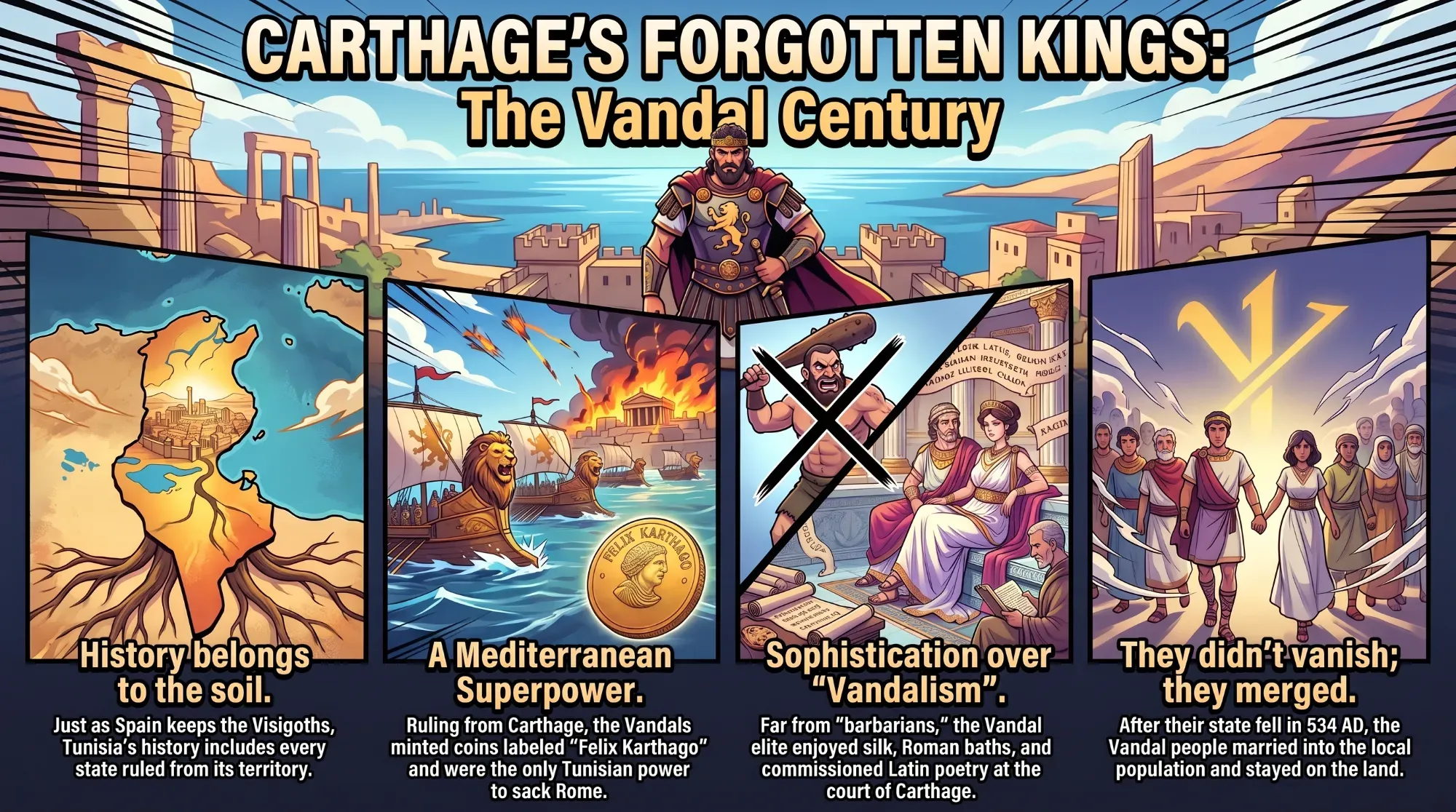
Spain keeps the Visigoths and Italy keeps the Lombards, though both were foreign, Arian, and gone. The Vandal kings ruled from Carthage for ninety-five years, struck silver reading Felix Karthago, and in 455 sailed from here to sack Rome. Tunisia keeps Hannibal, the Aghlabids, and the Turks, and files this century under Germany.
When a kingdom dies, who keeps its history?
Spain keeps the Visigoths: a foreign Germanic elite, Arian at first, destroyed in 711, gone as a named people, and still taught as the first political Spain. Italy keeps the Lombards, who came from the north, ruled from Pavia, and ended in 774; the region still carries their name. Germany keeps Prussia, a state abolished by decree in 1947 whose eastern lands were emptied. England keeps the Danes. None of these cases required the newcomers to be a majority, to survive as a label, or to leave descendants anyone can trace. The later nation inherited the record because the events happened on its soil. That rule is territorial, not ethnic.
Now Carthage. A kingdom sat there from 439 to 534. From that city it sacked Rome in 455. In 534 the state was destroyed and the name died. That is Toledo, Pavia, and Prussia. On the European rule, the record is local. On the African exception, it is exported to “Germanic barbarians,” and the land becomes only the harbour.
To keep a premodern kingdom is not to claim descent from it, legal succession to it, or approval of what it did. It is to treat the century as part of the national story because a state was based on this territory, ruled from it, projected power from it, and ended long ago, its people absorbed into those who followed. Every objection later raised against the Vandals was waived for Europe: foreign, Arian, a minority, short-lived, gone. Theodoric’s Ostrogoths were all five, and Italy keeps Ravenna. Spain was never asked for a blood test before it kept Toledo. The demand appears here, not there.
Tunisia already applies the territorial rule. It keeps Punic Carthage: Hannibal is Tunisian history. It keeps the Aghlabids, who sailed from Ifriqiya in 827, took Sicily, and in 846 sacked the outskirts of Rome and looted St Peter’s; the raid is taught as a deed launched from here. It keeps the Turks, a foreign elite that ruled for centuries and dissolved. It does not keep the Vandals. Ninety-five years of a kingdom ruling from Carthage, and the one occasion on which a power based in what is now Tunisia entered Rome by force, are not claimed. The period is studied, excavated, and labelled in museums; where it enters the national story at all, it enters from Rome’s side: a barbarian storm that passed over the province, never a fleet leaving home port. Three chapters kept, one not. The land is the same.
The facts of the century are not in dispute. The clean-break picture, a Vandal age wiped by a Byzantine reset, is Christian Courtois’s, from 1955.1 Scholarship of the last two decades reads the same years as continuity under a different king.2 Geiseric took Carthage in 439; the monarchy lasted until Belisarius restored imperial rule in 533–34. The fleet that entered Rome in 455 did not appear off Italy by accident. It sailed from a naval power based on this shore, recognised by Rome in the treaty of 442, and in 468 that power destroyed off Cape Bon the largest fleet Rome and Constantinople ever sent against it.3 It struck its silver at Carthage with the king on one face and the personification of the city on the other, holding corn-ears under the legend Felix Karthago.4 The state did not mint Germania. It minted Carthage.
Nor was the court a garrison. Procopius describes the Vandals of his day at the baths every morning, in silk, at the theatre and the hippodrome. The Anthologia Latina was compiled at Carthage under the last kings; Luxorius and Felix wrote Latin epigrams for Vandal patrons.5 Hilderic, who took the throne in 523, was the grandson of the emperor Valentinian III. He ended the persecution of the Catholics, restored the exiled bishops, and in 525 the African church held a general council at Carthage under his rule.6 That is what Spain dates itself from at Toledo in 589: an Arian crown reconciled to a Catholic province. Carthage did it sixty-four years earlier. Gelimer deposed Hilderic in 530, imprisoned him, blinded his nephew, and killed him only when Belisarius was already on the coast; no new persecution is recorded under him, and the council was not undone.7 Toledo fell in 711 and stayed Spanish history. Carthage fell in 534 and was filed under Germany.
In 534 Belisarius destroyed a state. He did not unmake ninety-five years of settlement, marriage, and children, and the conqueror’s own historian says so. Procopius, who sailed with Belisarius, records that Byzantine soldiers took Vandal wives and daughters in lawful marriage; that the women pressed their new husbands to claim the land held under the Vandals; and that when Constantinople refused, the army mutinied at Easter 536. He records, too, that the captured men were shipped east to serve as cavalry on the Persian frontier under the name Vandali Iustiniani, and that four hundred of them seized ships at Lesbos, sailed back, landed on an empty stretch of the African coast, and went up into the Aurès.8 The end of the kingdom was not the end of the people. What happened to them is what happened to every other settled elite whose state collapsed: they mixed into the population and ceased to be a separate name.
The ground says the same. At Makthar, in the interior, a three-aisled basilica of the Vandal century stands south of Trajan’s arch, with the tomb of a man named Hildeguns on the axis of its entrance. The Institut National du Patrimoine lists it as one of the rare surviving constructions of the period; Byzantine tombs were cut into the same floor after 534.9 At Haïdra, on the steppe near the Algerian border, a local family dated its inscriptions by the regnal years of Thrasamund and Hilderic. In the main basilica a bishop named Victorinus lies under an epitaph reading episcopus Vandalorum, a phrase Noël Duval, who led the Franco-Tunisian campaigns there in 1967–69, read as a later addition cut after the church returned to the Catholics.10 Someone came back to a bishop’s grave to write “of the Vandals” over it and left the grave where it was. The churches were not razed. They were kept, relabelled, and reused. That is the record from Kasserine and Siliana. What the Institut keeps, the national story does not claim.
Nineteenth-century ethnology had a rule for Africa: if something impressive stands on African ground, find another author. One instrument of that rule was the Hamitic hypothesis, which held that anything of worth on the continent had been carried in by Hamites, a supposedly superior race, what Edith Sanders called “a convenient explanation for all the signs of civilization found in Black Africa.”11 Great Zimbabwe was given to Phoenicians, Arabs, Solomon, anyone but the Shona, until archaeology broke the fraud. Egypt was “not African.” The kingdom’s own name went the same way: in 1794 a French bishop coined “vandalism” for the wrecking of monuments in the Revolution, and the word has stood in for the mint, the poets, and the council ever since.12 The continent could be the stage. It was not allowed to be the subject. The Vandal chapter is run through the same machine with a European cast: the kingdom is in Africa, so the will is filed as German; the sack of Rome is a storm from nowhere, not a fleet leaving Carthage; after 534 the people “vanish,” which keeps the deed from having a home on this shore. The story stays in Europe.
A sentence that would be ordinary in Madrid or Milan, that a kingdom on this soil belongs to this history, is treated as a provocation in Tunis. Not because the ruins are weaker. Because a European catastrophe with an African home port was never meant to be sayable.
To include the century is not to celebrate the sack of Rome, any more than Spain celebrates every massacre in the Americas it keeps on its books. It is to state that the act was launched from here. What remains is a choice: to file the century where the soil is, as Europe files its own, or to keep it out. Keeping it out is a decision with a documented origin, taken about the continent’s record for a century and a half. Whether Africa is the exception is the only thing left to decide, and it is not the evidence that decides it.
Notes
12
-
Christian Courtois, Les Vandales et l’Afrique (Paris: Arts et Métiers Graphiques, 1955). ↩
-
A. H. Merrills and R. Miles, The Vandals (Oxford: Wiley-Blackwell, 2010); Jonathan Conant, Staying Roman: Conquest and Identity in Africa and the Mediterranean, 439–700 (Cambridge: Cambridge University Press, 2012); Robin Whelan, Being Christian in Vandal Africa: The Politics of Orthodoxy in the Post-Imperial West (Oakland: University of California Press, 2018). ↩
-
Procopius, History of the Wars III.4.13 (the treaty of 442, by which Valentinian III recognised Vandal rule in Africa) and III.6.1–24 (the joint expedition of 468 under Basiliscus, anchored at the Promontory of Mercury, and its destruction by fire ships); Cedrenus gives the fleet as 1,113 ships. ↩
-
Silver 50 denarii of Hilderic (523–530), Carthage mint; obverse D N HILDIRIX REX, reverse Carthage standing with corn-ears, legend FELIX KARTG. Philip Grierson and Mark Blackburn, Medieval European Coinage, vol. 1 (Cambridge: Cambridge University Press, 1986), nos. 21–22; British Museum, BMC Vandals 3. ↩
-
Procopius, History of the Wars IV.6.5–9 (the Vandals’ way of life), trans. H. B. Dewing, Loeb Classical Library (Cambridge, MA: Harvard University Press, 1916); Anthologia Latina, ed. D. R. Shackleton Bailey (Stuttgart: Teubner, 1982), the collection assembled at Carthage in the last years of the kingdom, including the epigrams of Luxorius and Felix’s poems on Thrasamund’s baths at Alianae. ↩
-
Procopius, History of the Wars III.5.6 (Huneric’s marriage to Eudocia, daughter of Valentinian III) and III.9.1 (Hilderic’s accession and his toleration of the Catholics); the acts of the council of 525 in Charles Munier, ed., Concilia Africae a. 345–a. 525, Corpus Christianorum Series Latina 149 (Turnhout: Brepols, 1974). ↩
-
Procopius, History of the Wars III.9.3–14 (the deposition, the imprisonment of Hilderic, Hoamer, and Hoageis, the blinding of Hoamer, and Justinian’s protests), III.17.11–12 (the killing of Hilderic after Belisarius landed), IV.9.14 (Gelimer’s refusal to abjure Arianism after the defeat). No general anti-Nicene edict or mass exile is attested for 530–533; the African Catholic record of persecution remains that of Huneric and, more mildly, Thrasamund. ↩
-
Procopius, History of the Wars IV.14.8–10 (the marriages and the land claims), IV.14.17–19 (the Vandal prisoners formed into five cavalry units, the Vandali Iustiniani, for the eastern frontier; the four hundred at Lesbos, their landing in Libya, and their march to Mount Aurasium and Mauretania), IV.15 (the mutineers joined by Vandals); trans. H. B. Dewing, Loeb Classical Library (Cambridge, MA: Harvard University Press, 1916). ↩
-
Institut National du Patrimoine, “Makthar, l’antique Mactaris,” inp2020.tn, accessed September 2026: “une basilique d’époque vandale … considérée comme l’une des rares témoignages archéologiques de construction de cette période,” with the Hildeguns tomb in a masonry suggestus at the western entrance on the axis of the nave, and Byzantine tombs in the same church. ↩
-
Noël Duval, “L’église de l’évêque Melleus à Haïdra (Tunisie): la campagne franco-tunisienne de 1967,” CRAI 112, no. 2 (1968): 221–244; Duval, “Les églises d’Haïdra (églises dites de Melléus et de Candidus et ‘chapelle vandale’). Recherches franco-tunisiennes de 1969,” CRAI 113, no. 3 (1969): 409–436; Duval, with Françoise Prévot, Recherches archéologiques à Haïdra, I: Les inscriptions chrétiennes (Rome: École française de Rome, 1975); Duval, Recherches archéologiques à Haïdra, II: La basilique I dite de Melléus ou de Saint-Cyprien (Rome: École française de Rome, 1981). Duval’s reading of Vandalorum as a later addition is disputed by J. Durliat; the essay states it as Duval’s. ↩
-
Edith R. Sanders, “The Hamitic Hypothesis: Its Origin and Functions in Time Perspective,” Journal of African History 10, no. 4 (1969): 521. ↩
-
Henri Grégoire, “Rapport sur les inscriptions des monumens publics,” Convention nationale, 11 January 1794 (first use of the word), and “Rapport sur les destructions opérées par le vandalisme, et sur les moyens de le réprimer,” 14 fructidor an II (31 August 1794); Grégoire, Mémoires (Paris, 1837): “Je créai le mot pour tuer la chose.” On the three reports, Christine Tauber, Bilderstürme der Französischen Revolution: Die Vandalismusberichte des Abbé Grégoire (Freiburg, 2009). ↩
Get new pieces by email
Two to four essays a month. The list is never sold or shared, and you can unsubscribe in one click.
Comments
Comments are read before they appear. Disagreement is welcome; abuse is not.
No comments yet.