

The Two Readings
Mansa Musa and what each story costs.
The rich fool who threw away a treasury in Cairo and came home owing money: that biography was filed by the merchants who profited from the visit and fixed the rates on the loans. The rest of the record shows a treasury that survived succession and an army that annexed Gao while its king was away. The $400 billion prices an empire, not a man.
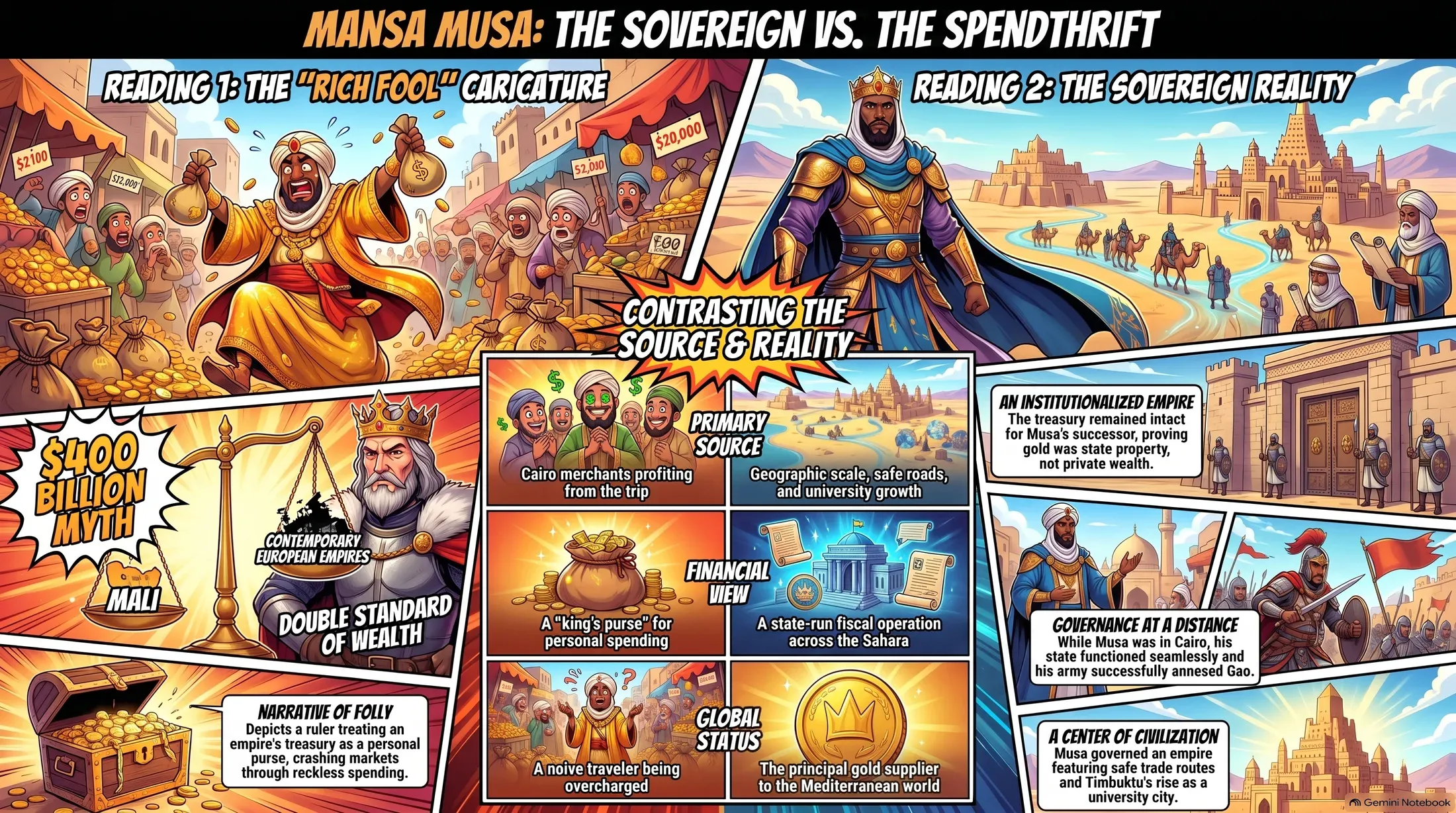
Two readings of Mansa Musa are available, and the lists have only ever printed one.
The first reading is the familiar one: a rich fool who treated an empire’s treasury as his personal purse, emptied it on spectacle in Cairo, crashed a gold market, and borrowed his way home.
The second reading is quieter and more expensive: a head of state who ran a fiscal operation across the Sahara, governed an empire at its documented peak, and whose pilgrimage entered the written record as the act of a sovereign of consequence.
The facts are not in dispute. Mali under Musa stood at its height: territory from the Atlantic past the Niger bend, the principal gold supplier to the Mediterranean world, trading as far as Venice and Genoa, Timbuktu rising into a university city, courts and roads a Moroccan traveler would soon describe as safer than anything he expected. Gold was the instrument of the state, not the state itself. While he was in Cairo his army annexed Gao; the state ran without him. The treasury passed intact to his brother. When a later mansa sold the state’s great gold boulder, the tradition treated it as squandering, a charge that only makes sense if the treasury was not the ruler’s private property.
The stories and the number have their own sources. The crash story and the loan story come from the same hand: the Cairo merchants who made incalculable profits from the visit and set the interest rates themselves. The people who filed his generosity as folly were the people eating from it, and their invoice became his only biography. The $400 billion was never cash he spent in Cairo; it is a modern figure that takes the gold economy of the Mali Empire, folds it into one man’s name, and runs it through an inflation table across six centuries that kept no price index. No European state had yet written a legal separation between a king’s purse and the public treasury; France did so two centuries after Musa’s death. Within fifty years of that death, European mapmakers drew him crowned at the center of West Africa.
Accept the first reading, and see what else you have accepted. A fool presided over an empire at its peak. A personal fortune behaved like an institution: it survived succession and punished the man who later raided it. A biography was taken from the party that profited from the transaction. The rule that a sovereign owns everything under the ground was applied to Musa and refused to Rome, to the caliphs, to the Yuan emperor whose China dwarfed Mali, to every crowned contemporary. Run evenly, the rule leaves him neither the richest man of all time nor even of his own century. The comparison holds only if Mali is priced as a private estate while every other empire is priced as a state. A legal standard was enforced two centuries before it existed anywhere in Europe: the Europe of 1566 measured against the Mali of the 1330s, a calendar trick presented as law. Run the same rule on the one modern ruler who actually held the written title the lists pretend Musa possessed, Léopold II, personal owner by Belgian statute and international recognition, and the crown transfers at once: the Congo’s untapped endowment, priced by the genre’s own logic, dwarfs the $400 billion by an order of magnitude. The genre has never run that test; it keeps a cruelty file on Léopold and no wealth file at all. The rich-fool story can be told. It cannot be told without contradiction.
Accept the second reading, and the costs are different. The $400 billion priced a state as a purse, and the richest-man title erased an empire: its farmers, builders, soldiers, teachers, and writers, the civilization the number was extracted from. The caricature is no longer a mistake; it is an operation with beneficiaries. The operation has a traceable logic. The pilgrimage forced Mali into the international written record as a wealthy and organized power. That record made the savage costume unusable. The naïve costume was the remaining option. The caricature is the residue of the achievement. And every casual retelling of the gold-crash story, in classrooms, in feeds, in ordinary conversation, becomes a small continuation of that erasure.
A third option is sometimes offered for safety: a great ruler who was also extravagant. The distributions in Cairo were large and public, but they occurred during a single major state event in which a sovereign was expected to give on a scale that matched his rank. In the political language of the time, open-handed arrival was ordinary sovereign behavior. The third option does not require a separate category. It sits inside the second.
The lists settled the question before they pretended to ask it. The only remaining question is which reading you are willing to carry.
Get new pieces by email
Two to four essays a month. The list is never sold or shared, and you can unsubscribe in one click.
Comments
Comments are read before they appear. Disagreement is welcome; abuse is not.
No comments yet.