

The Woman Who Moved Bethlehem to Kongo
Kimpa Vita, read from the file of her killers.
In 1706 a twenty-year-old prophetess was burned as a witch for teaching that Jesus was born in Kongo and that God wanted the slave wars ended. Everything we know of her survives in the handwriting of the men who pressed for the fire.
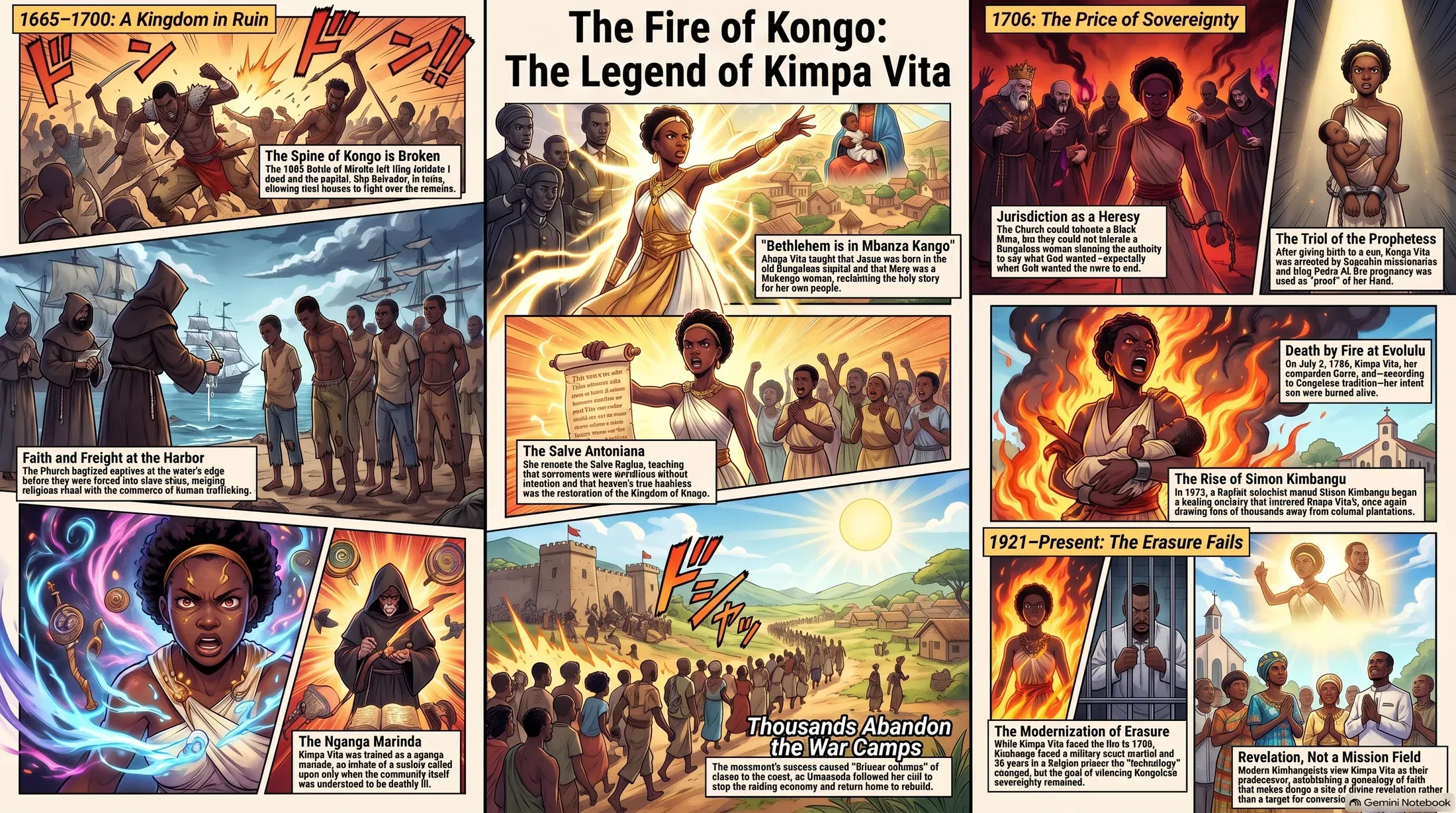
Early in the eighteenth century, a young Kongolese woman named Ndona Beatriz Kimpa Vita taught that Jesus had been born in Mbanza Kongo, the old capital of the Kingdom of Kongo. Mary was a Mukongo woman. God wanted the war camps abandoned and the sacred city rebuilt. Thousands obeyed. She was about twenty.
The kingdom she preached to was being eaten. The Battle of Mbwila in 1665 had broken its spine: Portuguese forces killed King António I, buried his severed head with ceremony in a Luanda chapel, and shipped the crown and sceptre of Kongo to Lisbon as trophies. São Salvador fell into ruin. Rival houses fought over the remains, captives became the currency of the wars, and the ships waited off the coast for it. At the harbor the Church kept pace with the commerce: captives were baptized at the water’s edge before the holds closed over them. Faith and freight cleared the same port.
Kimpa Vita was trained for exactly this kind of sickness. She was a nganga marinda, an initiate of the kimpasi society, the institution Kongo convened when the community itself was understood to be ill. She was also Catholic, heir to a Christianity that had stood at the Kongolese court since 1491 and prayed in Kikongo from a catechism printed in 1624. Both inheritances were hers by right, and she merged them without asking permission. Saint Anthony possessed her, she said. She died each Friday and spent the weekend with God. Of the prayers she had memorized as a child she rewrote the Salve Regina: in her Salve Antoniana the sacraments count for nothing without intention, Anthony holds the keys of heaven, and heaven’s business is the restoration of Kongo. Bethlehem became the ruined plaza of the capital. Salvation became a task with a deadline: leave the war camps, come home, rebuild.
None of this was strange on its face. Christians have always painted the holy in their own likeness; Italian masters gave Mary an Italian face and no one burned them for it. A Kongolese Mary was ordinary. The intolerable part was the jurisdiction: a Kongolese woman claiming the authority to say what God wanted, and reporting that what God wanted was the end of the wars that filled the ships. Her theology had a price, and other people were paying it. Thousands walking out of the raiding economy meant thinner columns to the coast. The missionaries and King Pedro IV faced a Christianity more coherent, more followed, and more Kongolese than anything they could offer.
Doctrine was never going to decide it, so her body was made to. She conceived a child by her companion Barro, hid the pregnancy, and withdrew to give birth in secret: her own measurement of the danger, and the measurement was exact. The Capuchins took the birth as their opening and pressed for her arrest. In their file the pregnancy convicted her of fraud, as if the saint’s vessel could not also be a woman. Whatever chastity could mean in a kingdom whose export was human beings, it was not a sovereignty women held, and the court that weighed her body sat inside the commerce that priced bodies.
It is an old procedure. Joan of Arc’s visions lost their protection the moment her clothing could be held against her; the Church burned her in 1431, retried her twenty-five years later, and crowned her a saint in 1920. The machinery that unburns a European prophet has never been switched on for a Kongolese one. Kimpa Vita’s file still says witch.
After the birth she went into hiding, and her child’s crying gave her away. Asked about him, she said he was a work of heaven. Pedro IV’s tribunal tried her with the older prophetess Appolonia Mafuta, the child, and the child’s father, and the judge pronounced death by fire on Beatriz, on Barro, and on the baby.¹ On 2 July 1706, at Evululu, the fire took them. And the record of the men who had pressed for the verdict makes exactly one claim of tenderness: that they drew the baby from the sentence, baptized him, and sent him on under a new name. A king’s head buried as a trophy. A crown shipped to Lisbon. Wars fed for forty years into the holds of ships. A prophet burned as a witch. And the single mercy in the file is a rescue that only its authors witnessed.² His name is António, son of Kimpa Vita.
What survives of her comes to us in their hand. The priests wrote her words down with care while they waited for the fire: the Kongolese Bethlehem, the verses of the Salve Antoniana, the claim that intention outweighs sacrament. They were documenting heresy; what they preserved was the theology they meant to destroy. Asked scornfully whether there were Black Kongolese in heaven, she answered that there were Kongolese there, but no colors, and da Gallo wrote down the sentence that refuted him. He also drew her: the single likeness of Kimpa Vita to cross three centuries is attributed to the man who filed the account of her killing. Custody did not loosen with time. Da Gallo’s report reached print in 1961. A Belgian bishop translated Da Lucca’s relations and issued them in Brussels in 1953 through the Institut Royal Colonial Belge, while Belgium ruled the Congo, two years after Simon Kimbangu died in a Belgian prison. One state, one decade, one press: publishing the Church’s own account of a woman the Church had sent to the fire, while its prisons held the man it had caged for the same offense.
They did not get the ending they filed. Da Lucca himself recorded that the Antonians grew more obstinate after the deaths, announcing that she had appeared at the tops of the highest trees of São Salvador, and a new woman rose to preach that if the daughter was dead, the mother remained. When Pedro IV retook São Salvador in 1709, his forces captured and sold many of her followers, and later wars pushed more of the baptized into the Middle Passage. They carried her Christianity with them. Its cadences surface in the songs of the Saint-Domingue revolutionaries: kanga mundele, kanga ndoki.
Two centuries later, in the same hills, the same act drew the same answer. A Baptist catechist named Simon Kimbangu began healing the sick at Nkamba in 1921, and Kongo did what it had done for Kimpa Vita: it got up and walked. Tens of thousands took the roads to Nkamba; plantations emptied, hospital beds emptied. The colony, like the kingdom, could tolerate any doctrine except the movement of its labor. Six months of ministry earned him a court-martial at Thysville under a single officer, no defense counsel, and a death sentence for disturbing the security of the State, commuted to life. The charge, at least, was honest: not heresy, security. He spent thirty years in a prison a thousand miles from home and died there in 1951. Fire for the prophetess, a cell for the prophet: the technology of erasure had modernized, the function had not.
The erasure failed twice. The Kimbanguists came out of the underground to practice Christianity on Kongolese terms, without Rome and without Canterbury: God addressed in Kikongo and Lingala, a holy city in Kongo Central, leadership Kongolese in an unbroken line. They entered the World Council of Churches in 1969, the first African independent church admitted, and the Council expelled them in 2021 on doctrinal grounds. The doctrine stayed; the membership went. And they do not remember Kimpa Vita as a predecessor. They hold that she prophesied Kimbangu, that her message was the coming of the Spirit and the liberation of Africa, and that the Catholic Church burned her for it. Their genealogy of revelation begins with her, which makes Kongo a site of revelation and not a mission field.
During her lifetime, Kongo Christianity was already African. What Kimpa Vita did was turn its authority against the commerce in human beings, and the commerce answered with fire. The smoke over the Angolan plateau in 1706 did not end the movement. It hardened it.
Notes
-
The sentence, and the child before the tribunal: the condemners’ own record. Bernardo da Gallo (1710), published in Louis Jadin, Le Congo et la secte des Antoniens, Bulletin de l’Institut historique belge de Rome, 33 (1961); Lorenzo da Lucca, in Jean Cuvelier, Relations sur le Congo du Père Laurent de Lucques, Brussels, Institut Royal Colonial Belge, 1953. Admitted against its authors.
-
The rescue exists solely in that same record, written for Rome by the men who had pressed for the verdict. No document outside their custody corroborates it, and the child never appears in any record again. Congolese transmission remembers him as António and holds that he burned with his parents; Congolese scholarship states it as fact: Mabiala Tsimba, “Kimpa Vita,” in The Encyclopaedia Africana Dictionary of African Biography, vol. 2, 1979. This publication does not admit the party that obtained a death sentence on an infant as the witness to its own mercy.
Get new pieces by email
Two to four essays a month. The list is never sold or shared, and you can unsubscribe in one click.
Comments
Comments are read before they appear. Disagreement is welcome; abuse is not.
No comments yet.