Tempus Nullius
An audit of the time defense.
Haiti paid France for its own freedom until 1947. Britain finished compensating slave owners in 2015. Germany retired its Versailles bonds in 2010. No court called those debts too old. Claims running the other way are always too late.
The Island of Palmas award, 1928. Max Huber, arbitrating between the United States and the Netherlands over title to a Pacific island, wrote the sentence the entire time defense rests on: a juridical fact must be appreciated in the light of the law contemporary with it. Note the case’s shape before the doctrine’s. Two colonial powers disputing ownership of an island whose inhabitants were parties to nothing; the doctrine of intertemporal law carries no non-European signature on its birth certificate. Ninety-eight years later, in March 2026, the United States explained its vote against Ghana’s resolution in that doctrine’s exact vocabulary: no right to reparations for wrongs not illegal under the law in force at the time. The chain from an arbitration between empires to a No vote against 123 states runs unbroken. It holds because the doctrine sounds like physics. The past is a foreign jurisdiction. Its law governs there. Nothing personal.
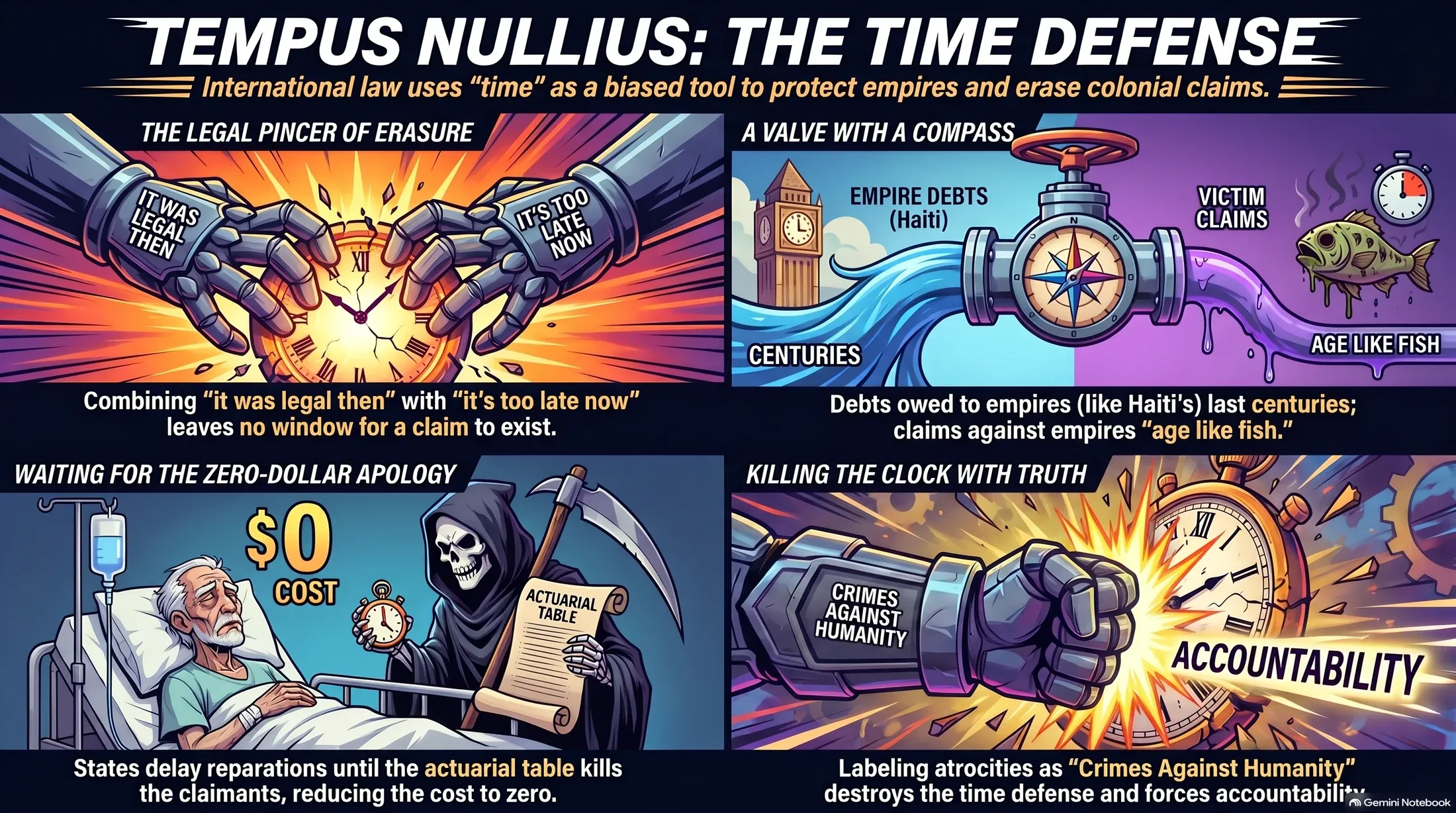
Stand where the claimant stands and run the clock both ways, and the physics turns out to be plumbing. Intertemporal law bars the claim from the past: no wrong existed then. Prescription bars it from the present: too late now. Between the two rules, there is no hour for the claim to exist. Each rule alone is answerable. Together they form a pincer, producing not a rejection on the merits, but a ruling that the claim has no time in which to occur. This publication’s name already contains the word for the operation. Sifr: zero. The nineteenth century declared the land vacant in order to take it. The twentieth and twenty-first declare the hour vacant in order to keep it. Terra nullius had a sequel, and the sequel is temporal: tempus nullius, the time of the claim ruled empty.
The lawgiver’s alibi
The General Act of Berlin, 1885, is the founding exhibit of “legal at the time,” and it fails the phrase’s own premise. Tempus regit actum assumes the era’s law stood outside the parties: a neutral frame both sides lived under. The international law of 1885 had a membership requirement, the standard of civilization, and it barred from lawmaking exactly the polities whose territory was being partitioned. The Sokoto Caliphate, Asante, Kongo, Buganda: capable of signing treaties whenever a treaty served the acquisition, incapable of sovereignty wherever sovereignty would have blocked it. So the defense, translated, reads: the act was legal under rules the perpetrators wrote, in a legislature the victims were barred from, for the purpose of performing the act. The crime’s paperwork doubles as the crime’s absolution. A rule authored by one party to the dispute is not a venerable principle of temporal fairness. It is the defendant’s brief, in Latin.
Time-laundering
Hanslope Park held the files of thirty-seven colonies for half a century while the Foreign Office denied they existed. A court forced them out in 2011; Britain settled with 5,228 living Mau Mau claimants within twenty-four months; and in 2018 forty thousand further Kenyan claims were dismissed because too much time had passed for a fair trial. Follow the delay as an asset. The state manufactured it by concealment, warehoused it for fifty years, then spent it in court as a defense. Private law anticipated exactly this move: fraudulent concealment tolls the limitation clock, because otherwise every successful fraud would ripen into innocence on schedule. Between a state and its former subjects, the tolling never arrives. The fraud ripens.
Independence set the same clock everywhere. A colonized claimant had no forum: the empire’s courts were the wrong bench and the only bench. The moment a forum theoretically opened at independence, limitation began to run against claimants whose evidence sat in the defendant’s locked buildings, in the defendant’s language, under the defendant’s classification stamps. The claim was born and began expiring in the same instant. Concealment is not the opposite of prescription. It is prescription’s supply chain.
The actuary
5,228 is a number worth staring at. It is the size of a class Britain agreed to pay: living, named, enumerable, shrinking. The forty thousand who followed were told their time had passed. The Windrush compensation scheme, built to repair the state’s own documentation purge, has moved slowly enough that dozens of claimants have died awaiting payment. The 2024 American apology for the boarding schools arrived with the government’s own count of at least 973 dead children and no compensation attached: a class fully converted from claimants into statistics before the contrition was released. Germany’s apology to the Ovaherero and Nama, still in interagency drafting, will arrive more than a century after the crime, addressed to a class containing no survivors.
A wider view reveals the pattern: states apologize freely for crimes whose victims are all dead, and litigate hardest wherever a claimant still breathes. The mechanism is simple. The price of an apology falls as its class dies, and the budget apology is timed to clear on the date the price reaches zero. Delay is not friction in the system. Delay is the system. The state’s cheapest litigator is the actuarial table: it bills by the year, and it has never lost on appeal.
Tense engineering
Durban’s famous clause runs the whole method inside one sentence: slavery is a crime against humanity and should always have been so. Present-tense morality, subjunctive law. Germany’s Joint Declaration concedes the atrocities would, from today’s perspective, be called genocide: a quarantine order served on the truth, valid now, therefore inert then. The 1.1 billion euros travel as development assistance across thirty years, executing a tense conversion in accounting. A debt points backward, a gift points forward, and the schedule discounts the sum through inflation and mortality until the past translates into a future nobody owes. Regret is an emotion about the past. Apology is an act with a future tense: it creates obligation. The budget apology is drafted to be a sentence with no future tense at all.
The one-way valve
In 1825, Charles X priced Haiti’s recognition at 150 million francs, payable to the dispossessed slaveholders, with a French squadron standing off Port-au-Prince to underline the invoice. Haiti borrowed from French banks to pay France, creating the double debt, and the payment stream ran until 1947. One hundred and twenty-two years. Across every Haitian government, through an American occupation, the claim never staled. No court found it too old. No doctrine of intertemporal law rose to observe that the world which created the debt had died. The schedule simply ran.
In 1835, Britain borrowed twenty million pounds to compensate some 46,000 slave owners for the loss of the people they owned; the freed received nothing. Asked about the loan in 2018, the Treasury answered in its own voice: the borrowing was not fully paid off until 2015. The sentence deserves its full weight. Living British taxpayers, among them descendants of the enslaved, serviced the owners’ compensation into the present decade, faithfully, at compound rates, without one doctrinal objection about the staleness of nineteenth-century obligations.
1919 completes the set from the other flank. Germany retired the last bonds of its Versailles reparations in October 2010, ninety-one years on, the claim having survived two currency collapses, a dictatorship, a partition and a reunification, because its creditors were European and intended to be paid. When a claimant Europe recognizes seeks the past, jurisdiction reaches back on demand. In 2004, the United States Supreme Court held in Altmann that the Foreign Sovereign Immunities Act applies retroactively to a taking from the 1940s. The Klimts left Vienna, and the Washington Principles processed Nazi-era claims as ordinary institutional business.
So the machinery exists. Old claims can be serviced for a century. Statutes can reach back sixty years when a court chooses. Compound schedules survive world wars when the creditor insists. Time presents no doctrinal obstacle anywhere in this record. What the record discloses is not a rule about time but a rule about direction. Claims running north age like bonds. Claims running south age like fish. Intertemporal law is a valve, and the valve has a compass.
Symmetric mathematics
Patnaik’s forty-five trillion for the Indian drain and Brattle’s twenty-four trillion for Britain’s slavery share are dismissed on arrival as fantasy arithmetic. This dismissal never engages the method, because the method is the dismisser’s own. Compound interest is not a reparations doctrine. It is how every gilt, consol and war bond in the creditor’s portfolio has always worked, pointed for once in the other direction. Britain compounded a slavery debt for 180 years without a word of complaint; the creditors were the owners. The fear of the compound claim is not fear of a large number. It is fear of symmetric time.
The border exception
Cairo, 1964. The Organisation of African Unity resolved to respect the borders existing at independence, and the resolution has held Berlin’s pencil lines in force for sixty years. The choice was African, made for the peace, and its price is a standing asymmetry: of everything drawn in the 1880s, exactly one artifact was granted eternal life, the map. The partitions of that decade are imprescriptible in practice; the takings of the same decade are prescriptible everywhere. The border may not lapse. The theft must. A broader view records the equilibrium’s African co-signatures, alongside the claims never filed from Delhi and Kinshasa. Whether the border bargain bought a peace worth its price is a live dispute. Sixty years of sanctity for the one colonial document Africa was never asked to sign is either the continent’s most successful act of pragmatism or its longest-running act of co-administration. The record supports both readings at once.
Clock-killers, clock-builders
Crime against humanity is the one legal category with no clock, which is the entire reason the drafting wars are fought over the label rather than the money. Durban’s subjunctive, Germany’s perspective clause, the American doctrine recited at the General Assembly, the fifty-two abstentions against Ghana’s resolution: every engagement is a battle over the label. Where it attaches, time dies as a defense. Brussels demonstrated the mechanism in December 2024. Once the Court of Appeal ruled the métis abductions a crime against humanity, imprescriptibility followed as a matter of course, and payment followed the word. The label killed the clock. The clock had been the whole defense.
The claimants’ countermeasures, read together, are all clock-building. The registry, because files compound and a file lets a claim outlive its bearer. Retroactive naming, 123 states resetting the legal calendar over the abstention wall. The advisory-opinion push at The Hague, which seeks a bench whose reading of time the debtor does not control. The standing tribunal, because New Zealand’s model shows what a claim looks like when time is its ally rather than its executioner: registered, heard, settled as administration, decade after decade, no heroics required. And at Thiaroye, the sharpest instrument of all: Senegal stopped petitioning for the archive and opened the ground. Registers can be doctored, but strata cannot. Calibres date bullets, chains date practice, and the earth keeps the one ledger the debtor never had in custody.
None of this asks Europe to travel back in time. The demand is narrower and harder: that Europe stop administering time, and permit the calendar that ran without complaint from 1825 to 1947 and from 1835 to 2015 to run in one further direction. In 1947, Port-au-Prince made its last payment on 1825. In 2015, London made its last payment on 1835. Neither debt was ever ruled too old. Neither ran south.
Get new pieces by email
Two to four essays a month. The list is never sold or shared, and you can unsubscribe in one click.
Comments
Comments are read before they appear. Disagreement is welcome; abuse is not.
No comments yet.