

Who Had to Prove They Weren’t Savages?
An inquest into a presumption that outlived race science.
Every land grab opens with a word: the people on the land are declared less than people. Scholarship spent the next century testing the word, with the victim in the dock and the accuser writing the questions. The other method was always available: name the speaker, date the wound that followed, and ask what the violence was for.
2126, a doctoral candidate submits a dissertation whose central finding is that the population starved and bombed in Gaza in the 2020s was not composed of human animals. The committee praises its restraint. A university press publishes it as a corrective.
A party that wants land, minerals, labor, or the removal of a population begins by declaring the people on the land less than people. The declaration was never a description; it is the first document in the file. The wound is the second. Then the absurdity: scholarship took that document as its opening hypothesis and spent a century testing it with the victim in the dock. Were they civilized? Were they cannibals? Were they capable of building anything? Primates without law or history? Vermin? The accuser had written the questions.
I am African. For the better part of a century, scholarship ran that dissertation about my continent and called it progress: they were not, after all, savages. The word “racist” is too blunt. A presumption about whose testimony counts by default, whose humanity is researchable by default, and who carries the burden of proof. A presumption is quieter than a slur. It outlives the science that minted it.
Reconstruction of an erased past is historical work under a special condition: the gap in the record is not weathering but demolition. The rehumanization genre does something else. It accepts as its research question the accuser’s opening claim that the people were less than human, then spends decades producing the acquittal. One project writes history against the demolition. The other answers a charge sheet drafted by the party that ordered the demolition.
Why was the question ever admissible?
Nathaniel Isaacs advised Henry Francis Fynn to depict the Zulu kings “as bloodthirsty as you can” because it would sell books and support land claims. Leopold’s cannibal propaganda was circulated by the holder of the rubber concession. The Cherokee were declared savages incapable of lawful ownership by the polity already surveying their land for a lottery. Interested testimony, discarded in any competent court. The academy heard it for a hundred years.
Evidence law in settler jurisdictions barred testimony from the colonized; the loot carried the material record to Europe; oral memory was ruled hearsay. The one-sided file that later “required” correction was manufactured to be one-sided. What presumption allowed a confessed interested witness to set a discipline’s research agenda? Toni Morrison named the mechanism: racism functions as distraction, keeping its targets “explaining, over and over again, your reason for being.” The century of rehumanization reads like that sentence with footnotes.
Did the evidence ever matter?
When Gertrude Caton-Thompson established in 1929 that Great Zimbabwe was African-built, the Rhodesian state suppressed the finding into the 1970s. Only the presumption was load-bearing. Violence had already been done, land had already moved, and the disciplines that might have named the fraud were still re-examining the victim’s humanity.
Is the charge fair?
The strongest answer against me is real. The working historian inherits the archive that exists; reading the colonizer’s record critically was often the only door. Much of what is now called “rehumanization” was never the West answering the monster question. Cheikh Anta Diop, the Ibadan school, Ki-Zerbo, and the African-led UNESCO General History of Africa were reconstruction addressed to the heirs, written from the expectation of history rather than the obligation to disprove savagery. Burn those works and you burn the exhibits.
The residual charge is exact. The offense was never the archive work. It was the court the work was filed in and the applause it was required to earn. The same document can serve two courts. Entered in the heirs’ claim to their own past, it is sovereignty. Submitted to the accuser’s, it is an acquittal that accepts the jurisdiction. The affirmative plea changes the mood, not the court: “civilization was never Western-only” flips the verdict, keeps the examiner, and leaves the standard standing for whoever fails it next. There is a third filing. The same document entered against the eraser is proof of the demolition: evidence for the prosecution, never a plea for the dead. A field that congratulates itself for finally discovering that Africans had history is confessing what it had assumed all along. That confession, not the recovery, is the charge.
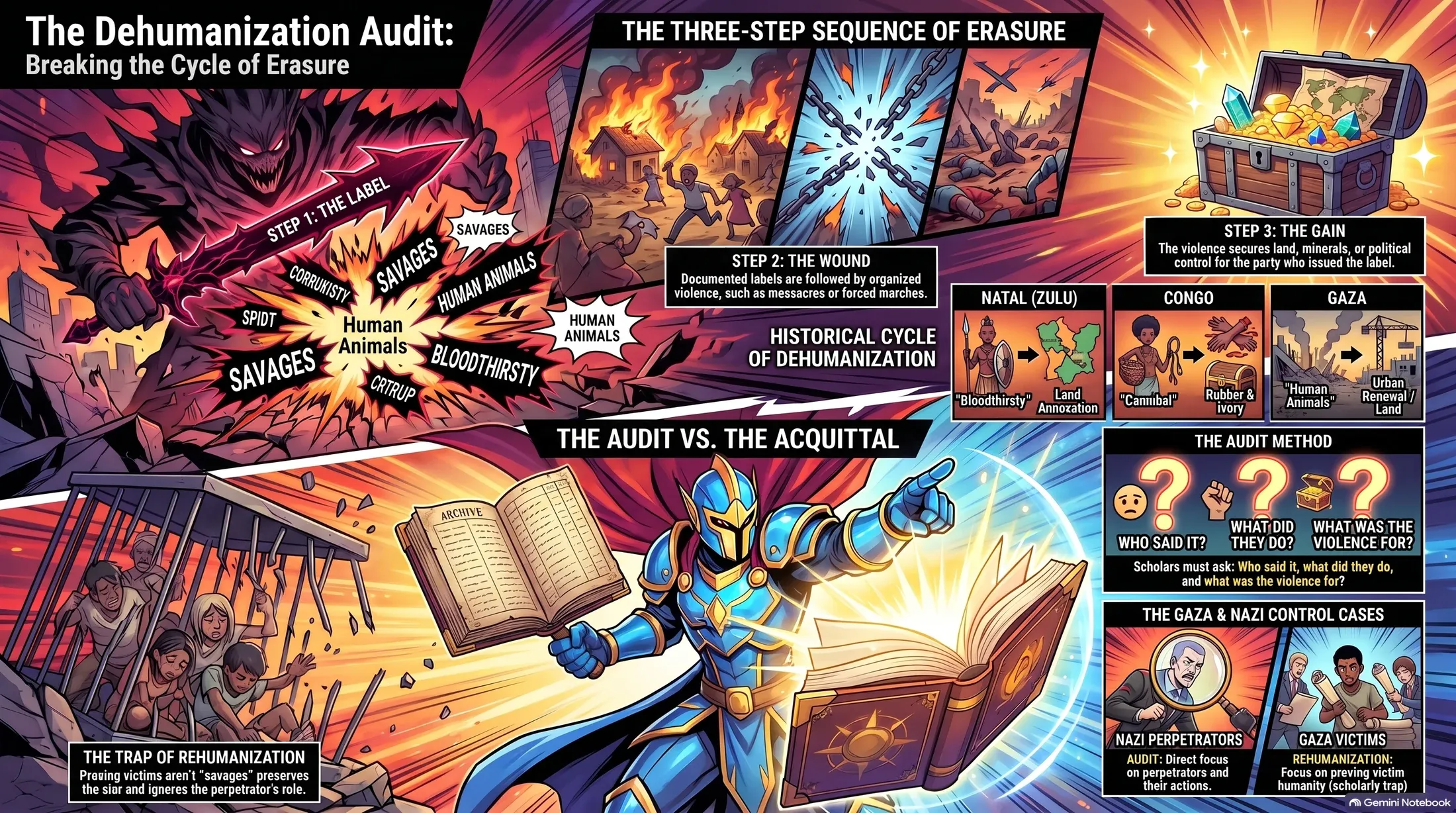
The test: when the word is followed by the wound, the question closes
When a documented dehumanizing label is issued by an identifiable party, and organized violence against the labeled group follows (publicly, traceably, and on a scale that cannot be dismissed as isolated acts), then the proper scholarly response is not to research whether the victims were subhuman. It is to audit the labelers and the violence itself.
A word followed by a bullet, a severed hand, a forced march, or a blocked food supply is not a hypothesis about the victim. It is a component of the act. Once that sequence is present, the question of the victims’ humanity is closed. The only open questions are what the perpetrators did, how the violence was organized, and what it was for.
A material or territorial gain appears: land, minerals, settlement, or a prospectus that prices the cleared ground. It is not, however, a required condition. Political control, demographic engineering, ideological purification, or the simple removal of a population from a territory are equally sufficient. Individual hatred operates inside these processes. The prior vocabulary and the organization already indicate purpose.
The method stays agnostic on the inner psychology of perpetrators. It tracks the word, the wound, and the goal of the wound.
The closed files meet the test.
Natal. Isaacs and Fynn called Shaka a bloodthirsty monster. Annexation followed. The land moved. Congo. Leopold’s cannibal vocabulary accompanied industrial violence by the Force Publique. The rubber and the ivory moved. Georgia. The Cherokee were declared savages. The Trail of Tears followed while the state lottery surveyed their land. Rwanda. Inyenzi ran on RTLM for months. Some 800,000 were killed. The goal was political: Hutu Power’s hold on the state. Houses and fields were occupied before the bodies were buried.
The scholarly question that should have been asked is: Who said it, what did they do, and what was the violence for? Too often the question became: Were they really savages? That second question is the scandal.
The open file
On 9 October 2023, two days after the Hamas-led attack that killed some 1,200 people in Israel, Defense Minister Yoav Gallant ordered a complete siege of Gaza and stated the reason in the same sentence: “We are fighting human animals and we are acting accordingly.”
The gain appeared in public documents. In 2024 Jared Kushner spoke of Gaza’s “waterfront property” and the possibility of moving the population while the territory was cleaned up. By 2025 a prospectus circulating in Washington described a trusteeship, tokenized land, and projected returns, pricing each departing resident as a cost saving. Israel’s finance minister later called the war “the demolition phase, which is always the first phase of urban renewal.” In 2026 the vision reached Davos: a masterplan showing towers, a port, and an airport.
Twenty-two months from adjective to prospectus. The test is met. The question “Were they human animals?” is not a scholarly inquiry. It is an extension of the original warrant. The only remaining question is the audit.
The control
Run the identical program on a different population. A research institute takes the Nazi descriptions of Jews as its open question and concludes, after decades, that they were not, after all, subhuman animals. The obscenity is immediate. Entertaining the question at all treats Mein Kampf as a research agenda.
If the Gaza dissertation still feels like ordinary scholarship while this second program feels like a moral catastrophe, nothing separates them except the population under the instrument.
The Jews of Europe were dehumanized, subjected to catastrophic violence, and dispossessed on an industrial scale. The scholarly response was an audit of the perpetrators: the Protocols was killed by proving plagiarism; the Holocaust was reconstructed from the perpetrators’ own paperwork; when David Irving sued Deborah Lipstadt, the court audited his footnotes. Nobody required the Jews of Europe to earn their humanity in a monograph. That refusal was correct. It is the treatment every dehumanized population should have received.
The method is older than its European proofs, and its first modern author worked from the audited side. In 1892, after three of her friends were lynched in Memphis, Ida B. Wells took the standing justification and audited it against the record. It collapsed. The gain stood in plain view: the People’s Grocery had competed with the white store across the street, and its owners died for it. Word, wound, goal, published as procedure, three decades before Graves touched the Protocols.
The silence in the acquittal
The rehumanization genre performs two functions. The first is to hand the victims a certificate of humanity. But an acquittal is not history. To spend a century proving a people are not savages is to permanently embed the word “savage” in their definition. You cannot negate a frame without preserving it.
The second, quieter function of this genre is to launder the perpetrators out of the final text. The 2126 dissertation will conclude that the population was not composed of human animals. It will not name the minister in its last sentence. It will not place his statement beside the first prospectus. The violence and the gain will sit in separate chapters or in no chapter at all. The dead are acquitted; the killers are not even defendants. The discipline celebrates its moral seriousness without having made an accusation.
The audit refuses that silence. It names the parties at every step. To a discipline that prizes neutrality, this looks like an accusation. For a century the academy has preferred a method that never has to name.
The file stays open
To an African, there is more dignity in watching the accuser audited than in being acquitted, once again, of savagery. A shelf of studies proving that one’s ancestors were not barbarians is a shelf that should never have been required. The alternative was always available: history written for the heirs, the file opened on the party that wrote the label. The audit was never waiting on the acquittal.
A century from now a doctoral candidate will open one of two files. One will retry the dead, acquit them again, and collect its praise, without naming the minister whose words began the sequence. The other will date the first prospectus, set the statement beside the death toll, and audit the sellers. The second method is already proven. What remains is whether it will be extended to everyone. That decision is being made now, in the present tense, and not by the dead.
Get new pieces by email
Two to four essays a month. The list is never sold or shared, and you can unsubscribe in one click.
Comments
Comments are read before they appear. Disagreement is welcome; abuse is not.
No comments yet.